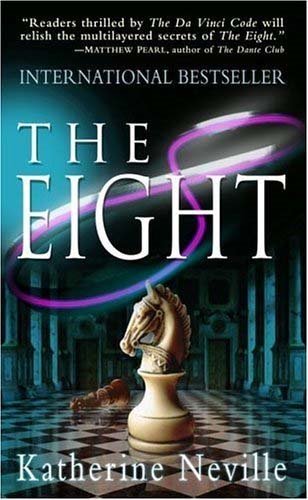
It's Friday, and I don't know about y'all, but it's been a long week for me. For most of you this is your last day of work before your weekend (lucky bastards), so instead of discussing the world of bookselling, let's discuss books.
Our favorite books.
Now don't get all scrambly-panicked because "Oh Dear GAWD! How can I pick just one!" because this isn't a test, nor is it a one time deal. This is just to get some titles out there for others to read and enjoy this weekend (if they have the time), or to keep in mind the next time they are at their local bookstore. They don't have to be "intellectual" or "literature." We don't judge. They just have to be books you enjoyed for some reason and that you would like others to enjoy too. If enough of you participate and if I have time, I'll compile the list on Sunday when I plan to do some updating on this site anyway.
Ready?
Here we go:
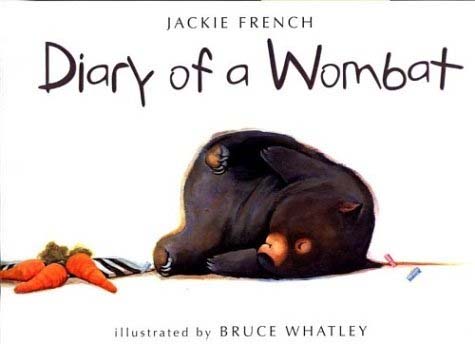
Diary of a Wombat is one of my all-time favorite books. Yes, it's a children's book. Yes, it is about a wombat and written in incomplete sentences. Yes, I give it to children and adults alike, from newborns to cancer patients. The sweet, cuddly illustrations by Bruce Whatley and the simple, yet cheeky statements by Jackie French's wombat get me every time (and fast becomes a favorite of anyone I had this to).
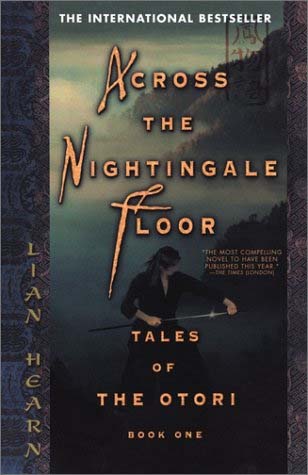
The Tales of the Otori, of which Across the Nightingale Floor is the first book, is one of those series that my store stumbled on by accident. We saw the cover in the magazine and ordered it in because all things Asian were proving to be popular with our readers. When we got it in we put it on the table and promptly forgot about it...until we realized we'd sold out.
In less than two weeks (which is fast for us, especially when we aren't actively handselling).
So we ordered more in. And sold out. Suddenly we had people asking for the next book, rabid to know what was happening next, so of course we had to read this book everyone was so crazy about.
I finished it in four hours, and rushed to work the next day so I could have someone to talk with about it. Lian Hearn has created a lyrical world based upon the Warlord/feudal (please ignore my spelling mistakes) world of Japan, and added an otherworldly element to his fighters. Never is the fantasy so heavy-handed that you see it as that, fantasy, but instead you just accept. Of course these people can magically split themselves while fighting, or throw their image. Duh. They're ninjas!
If you're looking for a book that combines battle, honor, love, and a boy just trying to discover who he is and what he believes in, this is the series for you. Written for adults, it was awarded the "Best Adult Novel for Teens" title by the American Library Association (I believe).
I read The Eight when I was eighteen and in England for the first (but hopefully not last) time. I don't remember where I picked it up, some bookstore in London probably, in between seeing the sights, but I do remember that I became so immersed in Neville's world that I don't remember anything between London and York. Neville wrote her twin stories (one taking place in the present and the other during the Napoleonic War if I remember correctly) in the early seventies, but the action and the adventure remained relevant. Based around the search for Charlemagne's chess set (I know, it sounds mundane, but it's not), this fast-paced story makes its predecessors like the Da Vinci Code look like drabble. Not to mention that kick-ass female characters abound and the fate of the world is to be decided.
Chess is war, after all, people.
I would continue to babble on about all three of these books, but I must go to work (where I do not have an internet connection, but I do have a lot of returns to box up), so let's hear yours.
(I'll come back and fill in all the links for these books later, but they are quite easy to find on Amazon)
Friday, March 31, 2006
Thursday, March 30, 2006
Doing My Homework #7: Special Orders
Yesterday I asked (in Orders Up) why people bother special ordering a book when they can easily get (almost) anything they want from Amazon.com and other online distributors. The answers I received (and y’all can still leave your response) highlighted exactly why the special ordering process is necessary for any store. All of you mentioned that special orders allow you to find books that you might not otherwise buy and gives you a chance to peruse the book before buying it. Since many stores will order without the promise of a sale, this is an excellent opportunity to check out the books that you might hesitate to buy immediately.
On the “Are you pondering what I’m pondering, Pinky?” thread Suisan asked, “If a customer special orders a book, is the store more likely to stock it?”
It depends on the book. In the past special orders have had a two-fold benefit: the customer gets the book that they’ve been looking for and I, the bookseller, get a chance to see titles that I may not have otherwise known about or remembered to order in. Just the other day I had a male customer order Alterknits. It was a book that looked like it would have wide appeal to my customer base, so I ordered in four more when making his special order. This doesn’t always happen at point of order (sometimes I have to get the product in and flip through it first), and it doesn’t happen with every book. If I had to estimate it would probably be about every one in five orders and only that many due to the people who are ordering books that we should have, but just haven’t gotten restocked on. These people act as a reminder for me to manually reorder the book for the store through the computer.
Of course there is a downside to special ordering. I’ve had people abuse the system, ordering a large quantity of some book to show an artificial boost in the books numbers or in the mistaken belief that the store will be stuck with the book if they don’t pick up their order. Both of these instances happened during the last presidential election, where people were going into bookstores and ordering large quantities of certain titles and giving false contact information. It was a waste of shipping costs, delivery, and bookseller hours to receive these books only to turn around and send them back when the order turned out to be a false one, not to mention it was very, very childish. I don’t know how it is for other stores, but if someone doesn’t pick up their order from us, and if we don’t think the product will appeal to our customer base, we send the book back to the distributor. It will only make it from behind the counter and on to the shelf if we think that the person will be at some later date (and just couldn’t make it in during their two-week pick up period), or if we think it will appeal to some other customer. Even then it is very doubtful that we’d keep 25 copies of something.
This touches on the importance of restocking systems in bookstores, something that Book Nerd touches on in her column “To Compute Or Not To Compute,” and a topic I’ll touch on in a later column. Is it important to have a system to restock sold books? Is it important to have a system that automatically reorders sold books for you? Could this system be a detriment in some cases?
On the “Are you pondering what I’m pondering, Pinky?” thread Suisan asked, “If a customer special orders a book, is the store more likely to stock it?”
It depends on the book. In the past special orders have had a two-fold benefit: the customer gets the book that they’ve been looking for and I, the bookseller, get a chance to see titles that I may not have otherwise known about or remembered to order in. Just the other day I had a male customer order Alterknits. It was a book that looked like it would have wide appeal to my customer base, so I ordered in four more when making his special order. This doesn’t always happen at point of order (sometimes I have to get the product in and flip through it first), and it doesn’t happen with every book. If I had to estimate it would probably be about every one in five orders and only that many due to the people who are ordering books that we should have, but just haven’t gotten restocked on. These people act as a reminder for me to manually reorder the book for the store through the computer.
Of course there is a downside to special ordering. I’ve had people abuse the system, ordering a large quantity of some book to show an artificial boost in the books numbers or in the mistaken belief that the store will be stuck with the book if they don’t pick up their order. Both of these instances happened during the last presidential election, where people were going into bookstores and ordering large quantities of certain titles and giving false contact information. It was a waste of shipping costs, delivery, and bookseller hours to receive these books only to turn around and send them back when the order turned out to be a false one, not to mention it was very, very childish. I don’t know how it is for other stores, but if someone doesn’t pick up their order from us, and if we don’t think the product will appeal to our customer base, we send the book back to the distributor. It will only make it from behind the counter and on to the shelf if we think that the person will be at some later date (and just couldn’t make it in during their two-week pick up period), or if we think it will appeal to some other customer. Even then it is very doubtful that we’d keep 25 copies of something.
This touches on the importance of restocking systems in bookstores, something that Book Nerd touches on in her column “To Compute Or Not To Compute,” and a topic I’ll touch on in a later column. Is it important to have a system to restock sold books? Is it important to have a system that automatically reorders sold books for you? Could this system be a detriment in some cases?
Labels:
Book Sense 101,
Doing My Homework,
Special Ordering
Wednesday, March 29, 2006
Orders up.
In a world with Amazon.com, halfpricebooks.com (what is the link to that), barnesandnobles.com, and others that allow you to find and purchase (almost) anything your heart desires and have it sent to your home, why should you (or do you) special order (ordering a book that store does not have in stock or carry to be picked up at that store) books through a brick and mortar store?
Have you tales of special ordering fiascos? Surprises? Happy stories of bookseller daring-do?
Let's hear them.
Have you tales of special ordering fiascos? Surprises? Happy stories of bookseller daring-do?
Let's hear them.
Tuesday, March 28, 2006
SB Day: The Importance of Being Witty in Historical Romance
“You must not laugh at me, darling, but it has always been a girlish dream of mine to love a man named Earnest.” ~Cecily, Act II, The Importance of Being Earnest.
“I'm always frank and earnest with women. Uh, in New York I'm Frank, and Chicago I'm Ernest.” ~Mitch Henessey (Samuel L. Jackson), The Long Kiss Goodnight
(Apologies. This would have been up last night, but I was distracted by friends, wine, and Wentworth Miller, and this girl is only so strong.)
I’ve seen the play, The Importance of Being Earnest, two or three times, and while I know that it was meant as Wilde’s “fuck you” to the aristocracy, I still find myself believing that a.) the play is about one act too long, and b.) I may one day kill one of the female characters. As I could not affect the length of the play or kill one of the actresses (that would be wrong), I let my mind go, and found myself contemplating Wilde’s legacy to Historical (read Regency, Victorian, etc) Romance.
And no, I’m not talking about how at the end of the play it’s revealed that Jack was not abandoned as a baby, but accidentally lost, and in reality is the older brother to his friend Algernon (and the son of a General), suddenly socially acceptable in all ways. We’ve all read the historical romance where the poor boy is suddenly discovered to have been a Duke or some member of the aristocracy all along (and has anyone else ever wondered how there are that many eligible young Dukes running around England unmarried? Anyone? Anyone? Bueller?). Often this sudden discovery at the last minute has me cracking plaster by throwing my book against the wall. ‘Cause yeah? No. I don’t think so.
What I’m talking about is the use of dialogue and social manners that Wilde displays in Earnest. While he was obviously not the first to create a social manners play (we can follow those back to the beginning of the written word), he was one that adopted it to a time period frequently inhabited by Romances. Take a look at Julia Quinn’s Bridgerton series, and you’ll see a melding of legacies. From Austen we received the beginning rapid-fire (yet socially correct) dialogue, but from Wilde comes the silly, the witty repartee verging on brainless that may in fact be imparting social commentary. Wilde let silly characters say brilliant things, but had the delivery in such an off-hand manner that these pronouncements never seemed out of character. Quinn and do the same with their characters, allowing fast dialogue to go from vapidness couched by societal norms to grow into plot development when the time is right. In skillful hands, the silly does not overwhelm but compliments the story, leaving you with a smile on your face long after its Happily Ever After.
And it must have a Happily Ever After. For as Wilde’s Miss Prism says, “The good ended happily, and the bad unhappily. That is what Fiction means.”
Especially in Romance.
“I'm always frank and earnest with women. Uh, in New York I'm Frank, and Chicago I'm Ernest.” ~Mitch Henessey (Samuel L. Jackson), The Long Kiss Goodnight
(Apologies. This would have been up last night, but I was distracted by friends, wine, and Wentworth Miller, and this girl is only so strong.)
I’ve seen the play, The Importance of Being Earnest, two or three times, and while I know that it was meant as Wilde’s “fuck you” to the aristocracy, I still find myself believing that a.) the play is about one act too long, and b.) I may one day kill one of the female characters. As I could not affect the length of the play or kill one of the actresses (that would be wrong), I let my mind go, and found myself contemplating Wilde’s legacy to Historical (read Regency, Victorian, etc) Romance.
And no, I’m not talking about how at the end of the play it’s revealed that Jack was not abandoned as a baby, but accidentally lost, and in reality is the older brother to his friend Algernon (and the son of a General), suddenly socially acceptable in all ways. We’ve all read the historical romance where the poor boy is suddenly discovered to have been a Duke or some member of the aristocracy all along (and has anyone else ever wondered how there are that many eligible young Dukes running around England unmarried? Anyone? Anyone? Bueller?). Often this sudden discovery at the last minute has me cracking plaster by throwing my book against the wall. ‘Cause yeah? No. I don’t think so.
What I’m talking about is the use of dialogue and social manners that Wilde displays in Earnest. While he was obviously not the first to create a social manners play (we can follow those back to the beginning of the written word), he was one that adopted it to a time period frequently inhabited by Romances. Take a look at Julia Quinn’s Bridgerton series, and you’ll see a melding of legacies. From Austen we received the beginning rapid-fire (yet socially correct) dialogue, but from Wilde comes the silly, the witty repartee verging on brainless that may in fact be imparting social commentary. Wilde let silly characters say brilliant things, but had the delivery in such an off-hand manner that these pronouncements never seemed out of character. Quinn and do the same with their characters, allowing fast dialogue to go from vapidness couched by societal norms to grow into plot development when the time is right. In skillful hands, the silly does not overwhelm but compliments the story, leaving you with a smile on your face long after its Happily Ever After.
And it must have a Happily Ever After. For as Wilde’s Miss Prism says, “The good ended happily, and the bad unhappily. That is what Fiction means.”
Especially in Romance.
Monday, March 27, 2006
Return of the Living Dead
I’m back, and it’s Smart Bitches Day (which I’ll get to later, after work. I swear. Don’t look at me like that). The theatre was good, as was the chaperoning of dozens of high school students (you didn’t think I got to go see plays for free, did you?), but I came back slightly exhausted and reminded that high school angst is like no other angst in the world.
Crazy.
In my absence many wonderful things happened:
So until I come back to dazzle y’all with my comparisons between Wilde’s fluff satire The Importance of Being Ernest and the life and times of Historical/Regency romance I ask you to ponder this completely unrelated topic:
We’ve all heard a variation of “Those who can, do. Those who can’t, teach/write/fill in the blank,” but recently I’ve also heard this:
Those who can, write/publish. Those who can’t, sell books.
So writers out there, do you think we booksellers are all wannabe writers? And booksellers, are we all wannabe writers? And if we are, would this represent a conflict of interest? The idea of booksellers can be extended to publishers as well (as y’all sell books at that much higher level).
I’m interested in your thoughts.
Crazy.
In my absence many wonderful things happened:
- You all were having an informative debate on the future of the audio book, and I really like what I’m reading, so please continue.
- My fangirl squeeing about Christopher Moore converted another reader (I suggest following up with Lamb and Fluke, Nicole, although Minty Fresh shows up first in Coyote Blue and the Mysterious Redhead is from Bloodsucking Fiends), thus reaffirming that my evil plan to turn Moore into the Tom Robbins of my generation is working (if only in my mind).
- I got a link to this song and music video from Beth and I may now be in love with Lemon Demon (the report remains unconfirmed at this time). Anything where Bill and Ted make a cartoon cameo has to be good.
- Publishers realize what I’ve been saying all along because, ya know, it all revolves around me. (Hmm, maybe I did spend a little too much time with those teenagers.)
So until I come back to dazzle y’all with my comparisons between Wilde’s fluff satire The Importance of Being Ernest and the life and times of Historical/Regency romance I ask you to ponder this completely unrelated topic:
We’ve all heard a variation of “Those who can, do. Those who can’t, teach/write/fill in the blank,” but recently I’ve also heard this:
Those who can, write/publish. Those who can’t, sell books.
So writers out there, do you think we booksellers are all wannabe writers? And booksellers, are we all wannabe writers? And if we are, would this represent a conflict of interest? The idea of booksellers can be extended to publishers as well (as y’all sell books at that much higher level).
I’m interested in your thoughts.
Wednesday, March 22, 2006
Announcements and Questions!
The Winnahs!
First and foremost, congratulations to MaryJanice Davidson for winning the hand selling contest with her hand sell for her book Undead and Unwed. It was a tight race with Jason Evans coming in second with his hand sell for Anne Frasier’s Before I Wake.
MaryJanice and Jason, please email me (via the address in the right hand column) with your favorite truffle choices from Moonstruck Chocolate and an address where I can ship your prize. If you’re allergic to chocolate, please, let me know, and I’ll come up with an alternative.
Thanks to everyone who submitted a hand sell and voted.
This Just In: Bookseller Chick Becomes Theatre Chick!
Just letting everyone know that I’ll be computerless (as far as I know) until Sunday because I’m going on vacation. Woo Hoo! Hopefully it will give me a chance to revive, see some wonderful plays and catch up on my reading. I’m planning to come back with some reviews, questions, another contest or two and some answers to more of those homework questions (p.s. check out Quinny’s response in the comments to “Doing My Homework #6: Product Placement and Co-op Marketing.” It’s not all publisher funded placement, the bookstore has its own agenda too).
Until then, puzzle me this:
What is the future of Audio books?
I’m sure I’m not the first (in fact I know I’m not the first) to bring this up, but let’s look at the future of audio books, shall we? Currently they run from cheap (14.99) to expensive ($75.00), light to cumbersome (wasn’t the last Harry Potter something like 22 CDs unabridged?), and abridged to unabridged, but they make a reasonable alternative for the person on the go who doesn’t have time to sit down and read. I have customers who listen to them in the car, while cleaning the house, or give them to their elderly relatives who can no longer read the small print of books.
Still, in this age of rapidly changing technology, they are behind the curve. Everyday I have customers ask for something they can download to their iPod or cell phone because they don’t want to bother with the multiply CDs or cassettes. Barnes & Noble and Borders responded by test-marketing Playaways—iPod sized, individually packaged audio books “with earphones, a lanyard, and a standard AAA battery to allow for immediate listening.”
Some libraries, meanwhile, now have the ability to allow you to download checked out audio books to your computer. Whether or not you can then download the file to your preferred choice of listening device, burn it to CD, or what, I don’t know. If you can then this cuts out the complaints other booksellers have passed on to me from customers about the Playaways. They either a.) want to be able to refill it, or b.) don’t want to be bothered to keep the Playaway after they’re done with it. One bookseller told me that a customer asked, “What do I do with it afterwards? Just put it on my shelf?”
Listen to it again later? Give it away? Donate it?
I don’t know, let’s ask Mr. Owl! (Sorry, I haven’t had enough coffee yet.)
What I do know is that the future of the audio book (and its method of delivery) is changing rapidly. Are Playaways the future or will it be kiosks in bookstores where you can download straight to your iAudio, iPod, or iriver? Maybe there will be audio book stations on XM Radio?
The future is wide open and I’m interested in your ideas. Where do you see audio books in the next few years?
First and foremost, congratulations to MaryJanice Davidson for winning the hand selling contest with her hand sell for her book Undead and Unwed. It was a tight race with Jason Evans coming in second with his hand sell for Anne Frasier’s Before I Wake.
MaryJanice and Jason, please email me (via the address in the right hand column) with your favorite truffle choices from Moonstruck Chocolate and an address where I can ship your prize. If you’re allergic to chocolate, please, let me know, and I’ll come up with an alternative.
Thanks to everyone who submitted a hand sell and voted.
This Just In: Bookseller Chick Becomes Theatre Chick!
Just letting everyone know that I’ll be computerless (as far as I know) until Sunday because I’m going on vacation. Woo Hoo! Hopefully it will give me a chance to revive, see some wonderful plays and catch up on my reading. I’m planning to come back with some reviews, questions, another contest or two and some answers to more of those homework questions (p.s. check out Quinny’s response in the comments to “Doing My Homework #6: Product Placement and Co-op Marketing.” It’s not all publisher funded placement, the bookstore has its own agenda too).
Until then, puzzle me this:
What is the future of Audio books?
I’m sure I’m not the first (in fact I know I’m not the first) to bring this up, but let’s look at the future of audio books, shall we? Currently they run from cheap (14.99) to expensive ($75.00), light to cumbersome (wasn’t the last Harry Potter something like 22 CDs unabridged?), and abridged to unabridged, but they make a reasonable alternative for the person on the go who doesn’t have time to sit down and read. I have customers who listen to them in the car, while cleaning the house, or give them to their elderly relatives who can no longer read the small print of books.
Still, in this age of rapidly changing technology, they are behind the curve. Everyday I have customers ask for something they can download to their iPod or cell phone because they don’t want to bother with the multiply CDs or cassettes. Barnes & Noble and Borders responded by test-marketing Playaways—iPod sized, individually packaged audio books “with earphones, a lanyard, and a standard AAA battery to allow for immediate listening.”
Some libraries, meanwhile, now have the ability to allow you to download checked out audio books to your computer. Whether or not you can then download the file to your preferred choice of listening device, burn it to CD, or what, I don’t know. If you can then this cuts out the complaints other booksellers have passed on to me from customers about the Playaways. They either a.) want to be able to refill it, or b.) don’t want to be bothered to keep the Playaway after they’re done with it. One bookseller told me that a customer asked, “What do I do with it afterwards? Just put it on my shelf?”
Listen to it again later? Give it away? Donate it?
I don’t know, let’s ask Mr. Owl! (Sorry, I haven’t had enough coffee yet.)
What I do know is that the future of the audio book (and its method of delivery) is changing rapidly. Are Playaways the future or will it be kiosks in bookstores where you can download straight to your iAudio, iPod, or iriver? Maybe there will be audio book stations on XM Radio?
The future is wide open and I’m interested in your ideas. Where do you see audio books in the next few years?
Tuesday, March 21, 2006
SB Day: It’s All Greek To Me
Note: Belated Smart Bitches Anniversary post on a topic I may have already posted on, but blogger is not helping me out here so I have no idea. Apologies in advance for the suckiness.
When it comes to being a hero in Romancelandia, it’s all about your sign, your Greek sign that is. Or perhaps I should say symbol. Are you an Alpha: big, strong and manly? A Beta: more cerebral, some dare might say geekish? Or are you an Omega, Theta, or Phi Delta Kappa (which all may not have definitions so much as frat boy followings)? Visit any discussion board and you’ll find these terms thrown around with some male name attached (Dane, Hawk, Connor, Ash, insert manly name here), and conversations like this:
Poster 1: Oh that Dane, he was so *swoon*
Poster 2: Really? I thought he was an asshole.
Poster 1: You mean Alpha.
Poster 2: Definitely that other A word. Asshole. He didn’t need to grab Rosaline like that! And his little woman attitude? Don’t get me started.
Poster 1: He was being protective! He just wanted to keep her safe!
Poster 2: I wished he’d been more like Bernard; he actually listened when Cecily told him something.
Poster 1: Bernard? But he’s so…Beta.
Poster 2: Reasonable.
Poster 1: A wimp.
Poster 2: Just because he didn’t go in busting down doors.
Poster 1: That’s because he would bounce off them. Did he have any muscle mass at all?
Definitions. Stereotypes. By labeling characters with them we begin to define them with a narrow focus. Alpha: Big, strong, and silent. Beta: talkative, friendly, and wimpy. Instead of letting the lines blur we allow ourselves to be pulled in by these two-dimensional definitions and then read (and accept) stories about men (read: Alphas) that we’d probably kick in the balls in real life.
Treat me like that, bucko? I don’t think so. See you in court.
Some would (and do) claim that romance novels represent a basic fissure in female nature. On one hand we claim that we want the guy who understands us and can communicate in real life, but then we go and read about these tough guys who tell us what to do and when to do it. Perhaps the best explanation of this phenomenon is given by the character Alan in Eric Berlin’s “The Line that Picked Up a Thousand Babes (And How It Can Work For You)” upon being blown off yet again:
Issues? Alan? Naah.
If he really is the nice guy that he’s claiming to be (despite the tantrum), Alan would be classified by the Romance Community as Beta (possibly with a side of, “Are you sure he’s not gay?”). In most novels he would be relegated to the role of wise-cracking sidekick who either doesn’t go in to the burning building at all (and if he does, he needs to be saved). He’s an enduring character in literature, but rarely ever the hero in Romancelandia (although he does occasionally get cast as the villain).
So why then, if this is true both of writing and nature, did the Beta Male definition continue on at all? I mean, he’s obviously not getting any. Christopher Moore claims in this new book, A Dirty Job* (which you should Go. Buy. NOW! Because it is out today), that:
It would appear that Christopher Moore agrees with the basic romance tenets from this definition, but this is not the case. Each and every one of his books star the “Beta” hero (and a few talking animals, but everyone needs to have their quirks), who runs the gambit between cowardice and heroism, who sometimes gets the girl, and who always makes you smile (even as he occasionally makes you cry). In other words, they’re real. They’re your little brother, your best guy friend, your boyfriend, and that guy you have a beer with while you catch the game. They’re not really Betas, because they’re not two-dimensional and to use that definition would be to ignore the qualities and realities woven into the character.
Moore does not write romance, and I’m sure that many in Romancelandia will never pick him up (but they should; they’re missing out), but his characterizations prove that definitions are limiting. I’ve met huge, muscled men who just want to be loved for what they’re like on the inside. I’ve met geeky boys who treat women like second class citizens who don’t have a brain in their heads. People, real people, are not so easily defined, and the same should apply to characters in books. Sure there are reasons for the consistent fascination with the Alpha, the slamming of the Beta, but writers should reach beyond that to the three-dimensionality that we celebrate in the real world.
*And just to be clear, this is not a reference book or a humor book. It's fiction. A mix of Meet Joe Black (sans Brad Pitt), a dash of tequila and a hit of acid thrown into a blender.
When it comes to being a hero in Romancelandia, it’s all about your sign, your Greek sign that is. Or perhaps I should say symbol. Are you an Alpha: big, strong and manly? A Beta: more cerebral, some dare might say geekish? Or are you an Omega, Theta, or Phi Delta Kappa (which all may not have definitions so much as frat boy followings)? Visit any discussion board and you’ll find these terms thrown around with some male name attached (Dane, Hawk, Connor, Ash, insert manly name here), and conversations like this:
Poster 1: Oh that Dane, he was so *swoon*
Poster 2: Really? I thought he was an asshole.
Poster 1: You mean Alpha.
Poster 2: Definitely that other A word. Asshole. He didn’t need to grab Rosaline like that! And his little woman attitude? Don’t get me started.
Poster 1: He was being protective! He just wanted to keep her safe!
Poster 2: I wished he’d been more like Bernard; he actually listened when Cecily told him something.
Poster 1: Bernard? But he’s so…Beta.
Poster 2: Reasonable.
Poster 1: A wimp.
Poster 2: Just because he didn’t go in busting down doors.
Poster 1: That’s because he would bounce off them. Did he have any muscle mass at all?
Definitions. Stereotypes. By labeling characters with them we begin to define them with a narrow focus. Alpha: Big, strong, and silent. Beta: talkative, friendly, and wimpy. Instead of letting the lines blur we allow ourselves to be pulled in by these two-dimensional definitions and then read (and accept) stories about men (read: Alphas) that we’d probably kick in the balls in real life.
Treat me like that, bucko? I don’t think so. See you in court.
Some would (and do) claim that romance novels represent a basic fissure in female nature. On one hand we claim that we want the guy who understands us and can communicate in real life, but then we go and read about these tough guys who tell us what to do and when to do it. Perhaps the best explanation of this phenomenon is given by the character Alan in Eric Berlin’s “The Line that Picked Up a Thousand Babes (And How It Can Work For You)” upon being blown off yet again:
I'm a nice guy. I'm a goddamn nice guy. I say that not because I think it's true, but because that's what everybody says. Ask any girl who's known me for more than a week, and that's how they'll describe me. "Alan? He's a nice guy." They say that because, you know, hell, you know nice guys, right? Don't try to hurt people, try to be a gentleman. Treat people right, especially girls. Because that's what we learned girls are attracted to, they want to be treated right. Right? You get a bunch of girls together and get them talking about guys, and they'll dream you up the perfect gentleman. But when it comes to real life, oh man!, that's very different. Because you get those girls together and get them talking about real men, not figments of their imagination, but real people, and what do you get? (Mimicking.) "Ohhh, men are cum! Men are slime! Men are shits!" (You notice how all those words begin with "S"? I think there's something to that.) So, men are all these "S" words, all these and more, but who do the girls date? Who comes on to them at bars and who do they go home with? The slime! The shits! And after they get hurt, and they always do, they all me up to confide in me, because long ago we decided that we were "just going to be friends." (I swear, you girls need to get a whole new vocabulary; you've started so many goddamn clichés it's not funny.) So, these girls call me up and they say, "Alan, all guys are sliiiime!" And then they realize that they're talking to a guy, and they say, "Oh, except you, Alan, you're a nice guy. When you find a girlfriend, she's going to be such a lucky girl. But it can't be me because, well, I'm attracted to guys that are going to shit all over me." So great. So now I have all the friends I need, so why should I be a nice guy anymore? Huh? I think I'll be a shit now. Yeah! I think I'll learn some stupid pick-up lines and use them on girls who are dressed to get laid. I think I'll be proud of how loud I can belch. I think I'll use women like they're Black
and Decker screwdrivers! Sure! That's what girls really want to hear! So great. Life begins now, okay? OKAY? Come on, babe, let’s go home and FUCK!
Issues? Alan? Naah.
If he really is the nice guy that he’s claiming to be (despite the tantrum), Alan would be classified by the Romance Community as Beta (possibly with a side of, “Are you sure he’s not gay?”). In most novels he would be relegated to the role of wise-cracking sidekick who either doesn’t go in to the burning building at all (and if he does, he needs to be saved). He’s an enduring character in literature, but rarely ever the hero in Romancelandia (although he does occasionally get cast as the villain).
So why then, if this is true both of writing and nature, did the Beta Male definition continue on at all? I mean, he’s obviously not getting any. Christopher Moore claims in this new book, A Dirty Job* (which you should Go. Buy. NOW! Because it is out today), that:
While Alpha Males are often gifted with superior physical attributes—size, strength, speed, good looks—selected by evolution over the cons by the strongest surviving and, essentially, getting all the girls, the Beta Male gene has survived not by meeting and overcoming adversity, but by anticipating and avoiding it. That is, when the Alpha Males were out charging after mastodons, the Beta Males could imagine in advance that attacking what was essentially an angry, woolly bulldozer with a pointy stick might be a losing proposition, so they hung back at camp to console the grieving widows.
It would appear that Christopher Moore agrees with the basic romance tenets from this definition, but this is not the case. Each and every one of his books star the “Beta” hero (and a few talking animals, but everyone needs to have their quirks), who runs the gambit between cowardice and heroism, who sometimes gets the girl, and who always makes you smile (even as he occasionally makes you cry). In other words, they’re real. They’re your little brother, your best guy friend, your boyfriend, and that guy you have a beer with while you catch the game. They’re not really Betas, because they’re not two-dimensional and to use that definition would be to ignore the qualities and realities woven into the character.
Moore does not write romance, and I’m sure that many in Romancelandia will never pick him up (but they should; they’re missing out), but his characterizations prove that definitions are limiting. I’ve met huge, muscled men who just want to be loved for what they’re like on the inside. I’ve met geeky boys who treat women like second class citizens who don’t have a brain in their heads. People, real people, are not so easily defined, and the same should apply to characters in books. Sure there are reasons for the consistent fascination with the Alpha, the slamming of the Beta, but writers should reach beyond that to the three-dimensionality that we celebrate in the real world.
*And just to be clear, this is not a reference book or a humor book. It's fiction. A mix of Meet Joe Black (sans Brad Pitt), a dash of tequila and a hit of acid thrown into a blender.
Monday, March 20, 2006
Smart Bitches Day Anniversary!
Today is the first anniversary of Smart Bitches Day over on Beth’s blog and I’m due over there soon with some virtual deviled eggs and Sangria. For those of you who are new here by way of others sites (hello), Smart Bitches Day is:
And we all feel this way about something, so on this day, the first anniversary of Great Bitchery, I ask that y’all join in. You can place your post in the comments (and therefore keep complete anonymity) or post on your own blog and just leave a link here. It can be literary or genre specific, it doesn’t have to be romance (Beth will understand), but it does have to be about books.
Because we love them. We really do. Otherwise y’all wouldn’t be here.
Meanwhile I’m going to think on my topic and post it when I get home from work tonight. It’s going to be really damn hard to top my Harlequin Presents post, or the Pregnancy one, or that one about underwear but I’m going to give it a try.
Until then blog, people, BLOG about your book loves and hates. We all have them.
P.S. If I haven't responded to your comments or emails from last week, I apologize. We've been moving sections in the store again (and doing returns, and backstocking), and I've been exhausted. Will get on all of that right away, I promise.
widely known as SBD, practiced by genre-lovers in all corners of the globe, beacon of
justice, keeper of truth, and heir to the throne of Carpathia. Et cetera, et cetera.Again, let me reiterate that SBD is all about the honest book-talkin'. Romance is kinda-sorta preferred, but certainly not a requirement. The only requirement is honesty. Find a book or a bookish topic that you love or hate - or something about your reading material in general that you love or hate - and talk to us about it like you'd talk to your friend. Thus "I felt the characters were perhaps not fully realized, but I do tend to be rather picky in that area so it's probably me, not the writing" becomes "Holy crap on a crapstick, why didn't she just name the characters Cardboard Smith and StickFigure Jones? For the love o'God, man."
And we all feel this way about something, so on this day, the first anniversary of Great Bitchery, I ask that y’all join in. You can place your post in the comments (and therefore keep complete anonymity) or post on your own blog and just leave a link here. It can be literary or genre specific, it doesn’t have to be romance (Beth will understand), but it does have to be about books.
Because we love them. We really do. Otherwise y’all wouldn’t be here.
Meanwhile I’m going to think on my topic and post it when I get home from work tonight. It’s going to be really damn hard to top my Harlequin Presents post, or the Pregnancy one, or that one about underwear but I’m going to give it a try.
Until then blog, people, BLOG about your book loves and hates. We all have them.
P.S. If I haven't responded to your comments or emails from last week, I apologize. We've been moving sections in the store again (and doing returns, and backstocking), and I've been exhausted. Will get on all of that right away, I promise.
Friday, March 17, 2006
Doing My Homework # 6: Product Placement and Co-op Marketing
On the “Are You Pondering What I’m Pondering, Pinky?” thread Christine Fletcher asked:
I don’t have a lot of familiarity with this whole process simply because the publisher never calls me and says, “Hey Bookseller Chick, we want you to put our friend here in a prominent place in your store. What do we have to do to make that happen?”
This is probably because they know that the “what” would involve publishing my destined to be a bestselling novel, Death by a Thousand Paper Cuts, a thrilling psychological tale written in iambic pentameter…and pig-latin.
No, this is a deal they make with the company or distributor (Ingram, Consortium, etc), with the buyers specifically (I would guess), long before the book ever shows up in my store, and therefore dooming DBATPC to the great slush pile in the sky. So left to the use of my own skills, I asked a few people and did some internet research.
Peter Spellman of Music Business Solutions offers up this explanation (albeit from the music perspective):
In more general terms, Steve Strauss says:
And this pretty much is the answer I got from the publishing folks who kindly answered when I asked, so let’s work with the generalities.
Warning: from this point on I’m just guessing. If anyone out there wants to speak up and confirm or deny (anonymously if necessary) please feel free).
Front of Store (FOS) placement is achieved (most easily) through the use of cardboard dumps that can be placed at the front entrance, beside tables and in windows. The customers attention will be captured by the display sign (hopefully, I’ve seen some wonderful ones) and the mass of the book (with possible inclusion of the backlist) in one place.
A more discrete—and tree friendly—alternative would be FOS placement due to the inclusion of the book in a sale. Bookseller A comes along to Publisher B and says, “Hey, I’m having a selected title buy four get the fifth book free sale. Do you want to be included?”
In this case I would assume (which may make an ass out of you and me, yes, I know) that the Publisher B would kick in some co-op dollars to help mitigate the cost of Bookseller A giving some books away for free. Since more than one publisher may be involved in this sale, the co-op costs would be spread between them.
Another way co-op dollars can be used is the way described in the music scenario. Bookseller A has a newsletter that they put out and Publisher B grants them image rights and dollars to include their new hot title. This newsletter may be print, and therefore a FOS freebie for customers as they come in (or leave), or it may be electronic.
FOS placement does not mean that a book will be a guaranteed success. Many factors—from book cover appeal to blurbs to hand selling to regional relevance to pre-sale buzz—play a part in making a book a hit, and it always uses an extra helping of luck.
I hope that this helps answer your question a little.
Can you please explain how "co-op" works, where publishers get to place books in more visible or prominent areas of the store?
I don’t have a lot of familiarity with this whole process simply because the publisher never calls me and says, “Hey Bookseller Chick, we want you to put our friend here in a prominent place in your store. What do we have to do to make that happen?”
This is probably because they know that the “what” would involve publishing my destined to be a bestselling novel, Death by a Thousand Paper Cuts, a thrilling psychological tale written in iambic pentameter…and pig-latin.
No, this is a deal they make with the company or distributor (Ingram, Consortium, etc), with the buyers specifically (I would guess), long before the book ever shows up in my store, and therefore dooming DBATPC to the great slush pile in the sky. So left to the use of my own skills, I asked a few people and did some internet research.
Peter Spellman of Music Business Solutions offers up this explanation (albeit from the music perspective):
Co-op advertising is a method by which a label can effectively pay for media space with product, preserving cash flow and maximizing the use of excess inventory. For example if you want to run an ad in a local newspaper advertising your new release and promote a local performance by your artist, the retailer will purchase the ad, deduct the cost of the media buy from its account with the distributor, then the distributor will deduct this amount from its account with the label. In return, the ad features your new release and the retailer is expected to make a significant "buy-in" of the product, give it favorable placement (end racks, etc.) and put the product on sale for a specified time period. This is a great way to get more media and retail exposure for your money. However, the distributors balance with the label should be significant enough to support this expenditure.
In more general terms, Steve Strauss says:
Co-op advertising is a cost-sharing arrangement between a manufacturer or supplier and a retailer whereby the manufacturer pays for a retailer's ad. Why? Because the retailer agrees to mention the manufacturer's product in the ad.
And this pretty much is the answer I got from the publishing folks who kindly answered when I asked, so let’s work with the generalities.
Warning: from this point on I’m just guessing. If anyone out there wants to speak up and confirm or deny (anonymously if necessary) please feel free).
Front of Store (FOS) placement is achieved (most easily) through the use of cardboard dumps that can be placed at the front entrance, beside tables and in windows. The customers attention will be captured by the display sign (hopefully, I’ve seen some wonderful ones) and the mass of the book (with possible inclusion of the backlist) in one place.
A more discrete—and tree friendly—alternative would be FOS placement due to the inclusion of the book in a sale. Bookseller A comes along to Publisher B and says, “Hey, I’m having a selected title buy four get the fifth book free sale. Do you want to be included?”
In this case I would assume (which may make an ass out of you and me, yes, I know) that the Publisher B would kick in some co-op dollars to help mitigate the cost of Bookseller A giving some books away for free. Since more than one publisher may be involved in this sale, the co-op costs would be spread between them.
Another way co-op dollars can be used is the way described in the music scenario. Bookseller A has a newsletter that they put out and Publisher B grants them image rights and dollars to include their new hot title. This newsletter may be print, and therefore a FOS freebie for customers as they come in (or leave), or it may be electronic.
FOS placement does not mean that a book will be a guaranteed success. Many factors—from book cover appeal to blurbs to hand selling to regional relevance to pre-sale buzz—play a part in making a book a hit, and it always uses an extra helping of luck.
I hope that this helps answer your question a little.
Labels:
Book Sense 101,
Co-op,
Doing My Homework,
Marketing
Thursday, March 16, 2006
Guest Blogs and Questionable Appearances
Just wanted to let you know that I have a guest blog up at Buzz, Balls & Hype. The wonderful Robert Gray of Fresh Eyes offered me the chance last week--thank you, thank you, thank you--but I had no idea when it would debut (can blogs debut?). If you've got time to kill, go check out my thoughts on chains in 500 words or less, and laugh at the fact that I forgot to hit the talking points of who I was and where to find me, forcing MJ or Bob to tack on the information to the title.
Talking points. Sheesh. I'd never make it as an author.
In other news, the Written Nerd's blog on bookstore cleanliness got me thinking about bookseller appearance. How do you identify a bookseller in your local store? Are you okay with them wearing jeans and a tee shirt, or do you expect slacks and a button-down? Do you care at all as long as they don't smell or do you expect a professional appearance to go with a professional demeanor?
Just wondering.
And since it continues to be a tight race, please go vote in the poll.
Talking points. Sheesh. I'd never make it as an author.
In other news, the Written Nerd's blog on bookstore cleanliness got me thinking about bookseller appearance. How do you identify a bookseller in your local store? Are you okay with them wearing jeans and a tee shirt, or do you expect slacks and a button-down? Do you care at all as long as they don't smell or do you expect a professional appearance to go with a professional demeanor?
Just wondering.
And since it continues to be a tight race, please go vote in the poll.
Wednesday, March 15, 2006
Hanging with Chloe and Manolo: Teen Lit, Branding, and the Reading of American Girls
Note: This is a continuation of thoughts expressed on the column, “From Tween to Teen and the Sex In Between,” read that first and the full thoughts left by readers.
Also let’s just define my “I’ll be back with my own thoughts after I get back from work” as “I’ll really be posting tomorrow.” I meant to type this up last night, but I got distracted by making dinner, doing dishes and taking emergency action to save my suddenly dishpan hands. So just bank that “little” definition in your Bookseller Chick dictionary along with planogram (awful, awful word) and other word that I threw out in my quest to explain the life of a chain store bookseller (although this one probably solely applies to me).
Okay? Okay.
JMC brings up an interesting point in her response to yesterday’s post and it really leads into where (I think) I want to go with this:
To me, it appears, she's blaming the publishers and the authors, not the parents, but we'll get to that in a minute.
It was a coworker who brought the Wolf article to my attention on Monday. She—an avid reader of the Gossip Girl and Clique books—asked me what I thought about Wolf’s stance on the subject manner, and when I confessed that I wasn’t up-to-date on my NYT Book Review reading, she summarized. She felt that Wolf over-emphasized the sex and drug aspects of the Gossip Girls books, agreed with her “Mean Girl” stance on the Clique books, but overall felt she missed the point of why these books are popular. “It’s not like these kids can’t see worse on television. I mean, look at The OC.”
Indeed, Gossip Girl et al are representative of the media culture presented to youth on television and movies. The absentee parents, the rampant materialism, the quest to be the most popular: all of these themes are featured regularly on The OC, One Tree Hill, and other teen drama shows. Even Veronica Mars and Gilmore Girls—shows lauded for their writing and acting—use these as plot points. In their defense they don’t seem to invert the parent/child power structure to the extent that Wolf claims the Clique does (or wipe them out all together as in the Gossip Girl books), but it’s there. Veronica’s rich friends have no parental controls at all and drive hummers and porches, Rory gets a Hermes bag from her boyfriend; pop culture references abound.
What I find interesting—and what Wolf leaves out in her article—is that these books (like these TV shows) have a secondary audience. Sure, they are marketed to the 13 and above Young Adult crowd, but they also appeal to adults. Sarah Weinman at GalleyCat refers to them as her “total guilty pleasure complex,” and she is not alone. My coworker is in her early twenties: smart, very literate, but capable of discussing Marc Jacobs in as much detail as she does feminist theory. Her materialistic quest to possess a Chloe bag does not detract from her ability to define herself outside of societal ideals. She just really wants that Chloe bag. Does her desire for a two thousand dollar bag keep her from making an informed decision? No.
Wolf argues that the through the inversion of the core “tradition [that] has been the opposition between the rebel and the popular, often wealthy antiheroine” has created a world where teens “try on adult values and customs as though they were going to wear them forever…offer[ing] the perks of the adult world not as escapist fantasy but in a creepily photorealistic way, just as the book jackets show real girls polished to an unreal gloss.” In the cases of my coworker and Weinman, she would suggest that both realize the unrealistic qualities of the world portrayed whereas teens would view themselves in this warped funhouse mirror and take the reflected image as truth.
This opinion is detrimental in two ways because it both denies a teenager’s ability to make an intelligent and informed decision and implies that parents should just buy other books, placing the onus of the shame and corruption of the teen mind that these books apparently cause on the writers, publishers and booksellers. In blame shifting this responsibility to the sellers and creators, she effectively denies the role of the parent, just as she claims these books do. Perhaps instead of focusing on the books, we should look to see why books about sex and drugs, why publishers feel the need to acknowledge the clothing designers on the cover, and why books on Mean Girl culture and parental absenteeism are so popular.
These are only symptoms of a greater disease. You can’t blame Gossip Girl, the A-List, and the Clique for latch-key children, teen credit debt, and a culture that tries to brand you as soon as you are able to have cognitive recognition of a symbol or word. You can’t blame them for creating an ideal because it was an ideal that put them in this situation. With both parents working sixty to seventy hour work weeks to achieve the American dream, the loss of after school programs and activities, overworked teachers, and the absence of a reliable teen mentorship program for all, it’s no surprise that teens redirect their focus outward and define themselves by what they know: advertising and products.
In some ways, these books go where a lot of parents don’t. They acknowledge that there are teens having sex and doing drugs, even if they glamorize it; they acknowledge that there is a culture of the mean girl—a culture that carries on into adulthood—something that books like Queen Bees and Wannabees and Tripping the Prom Queen are only now admitting to in the feminine world; and they acknowledge the power brands and the teenage buying public, which has been discussed thoroughly in the nonfiction book, Branded: the Buying and Selling of Teenagers. While they exaggerate and gloss over the alternatives and cons to the lifestyle, these books recognize—on some level—issues that teenagers actually deal with on a day to day basis.
It’s not my job as a bookseller to make these buying choices for the parent. Book Nerd points out (in the comments of the last column) “there's no way [that] trying to censor these books is the right answer. We have to give girls some credit for knowing the difference between an accurate representation of their experience and a fantasy.” Not only that, but we have to place the responsibility of teaching this difference on the people that will have the most influence: parents and teachers. As Lady T said in her column, it’s the parents who need to “Take the time and the responsibility to see what your kids may or not be influenced by.” Take the time to read the back of that glossy book before you throw it into your shopping cart or if you see it lying around the house. Maybe even take the time to read the book so that you can have an actual discussion with your child. Maybe then you’ll see that they are capable of distilling the truth from the advertising, or at least you’ll be able to send them on that direction.
Not too long ago I was helping a woman look for a book for her daughter, and she mentioned the girl really wanted to read the Sisterhood of the Traveling Pants series. When I asked the woman how old the girl was she replied that her daughter was twelve.
Because I had read and loved the books, I was aware of certain content, so I mentioned, “Well, one of the characters has sex in the first book, so—”
“They have sex? Never mind then,” the mother snapped, “I don’t want her reading about sex.”
I explained that one character—not all of them—has sex before she is ready, and the books deals with the fallout. I explained that teen sex wasn’t the main thread of the story, it was female friendship. I even mentioned that a lot of adult book clubs had chosen the book to review, so maybe it was something she could read and discuss with her daughter. The mother, however, had made up her mind about those books involving teen sex, and she didn’t have time to read everything her daughter did; she was just there to pick up a book because her child was actually reading!
She eventually came up to the counter with a Clique book.
Your thoughts as a parent? Bookseller? Author? What can be done to help treat the disease, not the symptoms?
Also let’s just define my “I’ll be back with my own thoughts after I get back from work” as “I’ll really be posting tomorrow.” I meant to type this up last night, but I got distracted by making dinner, doing dishes and taking emergency action to save my suddenly dishpan hands. So just bank that “little” definition in your Bookseller Chick dictionary along with planogram (awful, awful word) and other word that I threw out in my quest to explain the life of a chain store bookseller (although this one probably solely applies to me).
Okay? Okay.
JMC brings up an interesting point in her response to yesterday’s post and it really leads into where (I think) I want to go with this:
…I'm not sure who the recipient of the diatribe was supposed to be. The authors for writing what she thinks is materialistic crap? Parents for not paying attention to what their kids are read[ing]? Publishers for putting a product on the market?
To me, it appears, she's blaming the publishers and the authors, not the parents, but we'll get to that in a minute.
It was a coworker who brought the Wolf article to my attention on Monday. She—an avid reader of the Gossip Girl and Clique books—asked me what I thought about Wolf’s stance on the subject manner, and when I confessed that I wasn’t up-to-date on my NYT Book Review reading, she summarized. She felt that Wolf over-emphasized the sex and drug aspects of the Gossip Girls books, agreed with her “Mean Girl” stance on the Clique books, but overall felt she missed the point of why these books are popular. “It’s not like these kids can’t see worse on television. I mean, look at The OC.”
Indeed, Gossip Girl et al are representative of the media culture presented to youth on television and movies. The absentee parents, the rampant materialism, the quest to be the most popular: all of these themes are featured regularly on The OC, One Tree Hill, and other teen drama shows. Even Veronica Mars and Gilmore Girls—shows lauded for their writing and acting—use these as plot points. In their defense they don’t seem to invert the parent/child power structure to the extent that Wolf claims the Clique does (or wipe them out all together as in the Gossip Girl books), but it’s there. Veronica’s rich friends have no parental controls at all and drive hummers and porches, Rory gets a Hermes bag from her boyfriend; pop culture references abound.
What I find interesting—and what Wolf leaves out in her article—is that these books (like these TV shows) have a secondary audience. Sure, they are marketed to the 13 and above Young Adult crowd, but they also appeal to adults. Sarah Weinman at GalleyCat refers to them as her “total guilty pleasure complex,” and she is not alone. My coworker is in her early twenties: smart, very literate, but capable of discussing Marc Jacobs in as much detail as she does feminist theory. Her materialistic quest to possess a Chloe bag does not detract from her ability to define herself outside of societal ideals. She just really wants that Chloe bag. Does her desire for a two thousand dollar bag keep her from making an informed decision? No.
Wolf argues that the through the inversion of the core “tradition [that] has been the opposition between the rebel and the popular, often wealthy antiheroine” has created a world where teens “try on adult values and customs as though they were going to wear them forever…offer[ing] the perks of the adult world not as escapist fantasy but in a creepily photorealistic way, just as the book jackets show real girls polished to an unreal gloss.” In the cases of my coworker and Weinman, she would suggest that both realize the unrealistic qualities of the world portrayed whereas teens would view themselves in this warped funhouse mirror and take the reflected image as truth.
This opinion is detrimental in two ways because it both denies a teenager’s ability to make an intelligent and informed decision and implies that parents should just buy other books, placing the onus of the shame and corruption of the teen mind that these books apparently cause on the writers, publishers and booksellers. In blame shifting this responsibility to the sellers and creators, she effectively denies the role of the parent, just as she claims these books do. Perhaps instead of focusing on the books, we should look to see why books about sex and drugs, why publishers feel the need to acknowledge the clothing designers on the cover, and why books on Mean Girl culture and parental absenteeism are so popular.
These are only symptoms of a greater disease. You can’t blame Gossip Girl, the A-List, and the Clique for latch-key children, teen credit debt, and a culture that tries to brand you as soon as you are able to have cognitive recognition of a symbol or word. You can’t blame them for creating an ideal because it was an ideal that put them in this situation. With both parents working sixty to seventy hour work weeks to achieve the American dream, the loss of after school programs and activities, overworked teachers, and the absence of a reliable teen mentorship program for all, it’s no surprise that teens redirect their focus outward and define themselves by what they know: advertising and products.
In some ways, these books go where a lot of parents don’t. They acknowledge that there are teens having sex and doing drugs, even if they glamorize it; they acknowledge that there is a culture of the mean girl—a culture that carries on into adulthood—something that books like Queen Bees and Wannabees and Tripping the Prom Queen are only now admitting to in the feminine world; and they acknowledge the power brands and the teenage buying public, which has been discussed thoroughly in the nonfiction book, Branded: the Buying and Selling of Teenagers. While they exaggerate and gloss over the alternatives and cons to the lifestyle, these books recognize—on some level—issues that teenagers actually deal with on a day to day basis.
It’s not my job as a bookseller to make these buying choices for the parent. Book Nerd points out (in the comments of the last column) “there's no way [that] trying to censor these books is the right answer. We have to give girls some credit for knowing the difference between an accurate representation of their experience and a fantasy.” Not only that, but we have to place the responsibility of teaching this difference on the people that will have the most influence: parents and teachers. As Lady T said in her column, it’s the parents who need to “Take the time and the responsibility to see what your kids may or not be influenced by.” Take the time to read the back of that glossy book before you throw it into your shopping cart or if you see it lying around the house. Maybe even take the time to read the book so that you can have an actual discussion with your child. Maybe then you’ll see that they are capable of distilling the truth from the advertising, or at least you’ll be able to send them on that direction.
Not too long ago I was helping a woman look for a book for her daughter, and she mentioned the girl really wanted to read the Sisterhood of the Traveling Pants series. When I asked the woman how old the girl was she replied that her daughter was twelve.
Because I had read and loved the books, I was aware of certain content, so I mentioned, “Well, one of the characters has sex in the first book, so—”
“They have sex? Never mind then,” the mother snapped, “I don’t want her reading about sex.”
I explained that one character—not all of them—has sex before she is ready, and the books deals with the fallout. I explained that teen sex wasn’t the main thread of the story, it was female friendship. I even mentioned that a lot of adult book clubs had chosen the book to review, so maybe it was something she could read and discuss with her daughter. The mother, however, had made up her mind about those books involving teen sex, and she didn’t have time to read everything her daughter did; she was just there to pick up a book because her child was actually reading!
She eventually came up to the counter with a Clique book.
***
Your thoughts as a parent? Bookseller? Author? What can be done to help treat the disease, not the symptoms?
Tuesday, March 14, 2006
From Tween to Teen and the Sex In Between
In Sunday's NYT Book Review, Naomi Wolf shared her thoughts on the popular books in the teen market. The article entitled, "Young Adult Fiction: Wild Things," takes to task Gossip Girl, the Clique and the A List for promoting sex, drugs and a materialistic culture, while desecrating the importance of parent/child disciplinary relationships. Read the article, check out Lady T's response "Is Naomi crying Wolf over Teen reads?" and then head back here and share your thoughts. I'll be back with my own thoughts after I get back from work, but I will share with you this:
Wolf says in her opening paragraph that:
My response is what? What are you doing picking up a book for your kid without at least reading the back? Aren't the words Clique, Gossip, and A-List representative enough of what they are about? When have those words (with the possible exception of the A-List) had positive connotations?
Let's here your thoughts on Naomi's teen reads. Oh, and while you're at it, go vote.
Wolf says in her opening paragraph that:
They [the books] feature sleek, conventionally beautiful girls lounging, getting in or out of limos, laughing and striking poses. Any parent — including me — might put them in the Barnes & Noble basket without a second glance.
My response is what? What are you doing picking up a book for your kid without at least reading the back? Aren't the words Clique, Gossip, and A-List representative enough of what they are about? When have those words (with the possible exception of the A-List) had positive connotations?
Let's here your thoughts on Naomi's teen reads. Oh, and while you're at it, go vote.
Monday, March 13, 2006
The Poll!!!
ETA: Okay, it works! It works. Let's try this again.
Despite what my negligence may suggest (I really meant to get to this yesterday), we had a really great selection of books and hand sells offered up for your voting pleasure. All of them beat my immortal hand sell for The Island of the Sequined Love Nun that started with "How can you resist something with a talking fruit bat..."
But really, how can you?
Anyway, below are your choices, so read and vote so I can send one of these lovely people a prize (I'm thinking chocolate, but there might be a couple of choices). Please vote once, be fair and let me know if you have any issues with the poll. Voting will run through until Friday, March 17th, at 6:30 pm.
It's got this kid, a boy, and this bear, see. But there are other animals too. They, er, all live near each other and visit each other a lot. The bear eats as much honey as he can. It could use more female characters -- there's only one and she's a mother figure -- but it's a pretty appealing book--set of books actually -- anyway. By Kate R
Shadow of The Wind is like one of those old fashioned Hollywood movies-it has mystery,romance and a great opening scene set in The Cemetary of Forgotten Books! This is the first of Carlos Ruiz Zafron's books to be translated and I for one, look forward to reading more.
By lady t
UNDEAD AND UNWED is about a secretary who loses her job and then gets run over by a Pontiac Aztec. When she wakes up in the morgue, she has no idea she's the queen of the vampires. Hilarity ensues.Written by...me! Hee. --MaryJanice Davidson
By MaryJanice
Are you afraid of the dark? Not if someone's with you, right? But what if that someone is a killer. His thoughts. His philosophy. His words. What if you forgot who you are?Arden Davis knows this killer. Can she catch him? Perhaps. But first she must find herself.Before I Wake by Anne Frasier.
By jason evans
Need some good mommy talk? [hand book to patron]. You know the good birthing disasters and is-it-really-this-hard discussions. Well, trust me, LITTLE EARTHQUAKES (Jennifer Weiner) is all that and then some tears. Really. I've read it whenever I need a pick me up. Or some girlfriends and can't get away.
By Bethany
Voting Now Closed! Stay tuned for the results.
Despite what my negligence may suggest (I really meant to get to this yesterday), we had a really great selection of books and hand sells offered up for your voting pleasure. All of them beat my immortal hand sell for The Island of the Sequined Love Nun that started with "How can you resist something with a talking fruit bat..."
But really, how can you?
Anyway, below are your choices, so read and vote so I can send one of these lovely people a prize (I'm thinking chocolate, but there might be a couple of choices). Please vote once, be fair and let me know if you have any issues with the poll. Voting will run through until Friday, March 17th, at 6:30 pm.
It's got this kid, a boy, and this bear, see. But there are other animals too. They, er, all live near each other and visit each other a lot. The bear eats as much honey as he can. It could use more female characters -- there's only one and she's a mother figure -- but it's a pretty appealing book--set of books actually -- anyway. By Kate R
Shadow of The Wind is like one of those old fashioned Hollywood movies-it has mystery,romance and a great opening scene set in The Cemetary of Forgotten Books! This is the first of Carlos Ruiz Zafron's books to be translated and I for one, look forward to reading more.
By lady t
UNDEAD AND UNWED is about a secretary who loses her job and then gets run over by a Pontiac Aztec. When she wakes up in the morgue, she has no idea she's the queen of the vampires. Hilarity ensues.Written by...me! Hee. --MaryJanice Davidson
By MaryJanice
Are you afraid of the dark? Not if someone's with you, right? But what if that someone is a killer. His thoughts. His philosophy. His words. What if you forgot who you are?Arden Davis knows this killer. Can she catch him? Perhaps. But first she must find herself.Before I Wake by Anne Frasier.
By jason evans
Need some good mommy talk? [hand book to patron]. You know the good birthing disasters and is-it-really-this-hard discussions. Well, trust me, LITTLE EARTHQUAKES (Jennifer Weiner) is all that and then some tears. Really. I've read it whenever I need a pick me up. Or some girlfriends and can't get away.
By Bethany
Voting Now Closed! Stay tuned for the results.
SB Day: I’d Much Rather Be a Murderous Old Lady
It’s Smart Bitches Day again and that means ranting and raving, so let’s go back, waaaaay back to the days when I once considered acting to be the Coolest. Thing. Evar. And the idea of starving for my art was just that, an idea, because the truth was three wonderful meals a day and full refrigerator at the house.
Sigh. Those were the days. Glorious prepared for me food, I miss you.
Anyway back in the teen angst soaked days of high school I did a lot of theatre in a department that was actually pretty good (comparatively speaking, there are some baaaaad high school productions out there and we’ve all had to sit through them), and managed to land significant roles in almost all the plays of Junior and Senior years, the last of which was the role of Martha in Arsenic and Old Lace. She was the second of the sweet, old, murderous lady leads, if you’re unfamiliar with the play. Not that she thought of herself as murderous. Oh, no.
We’re just providing them with rest, dear.
During the audition process, though, I was also up for the female romantic lead. The ingénue, Elaine. It would have been my first romantic lead, something I’d managed to avoid in my years of playing supporting characters—flighty moms, best friends, doctors—and something most young actresses would kill for. Only I didn’t want to be Elaine, despite my ability to horror movie scream with the best of them; Elaine was the sweet little innocent, she didn’t make things happen, they just happened to her.
She definitely didn’t poison little old men.
“You’re not trying,” my director would yell at me during the Elaine auditions. “You could have this if you would just try.”
No can do, bucko, I’m just not the girl who needs saving, and I don’t have a lot of respect for the girl who does.
This attitude pretty much sums up my relationship with the heroines in romance novels. If she’s strong, take charge (even if it’s a limited take charge because of the era she lives in), and doesn’t wait around for some man to save her butt, I’m with her all the way. I cheer her choices, and support her decisions. Hell, I’ll even support her if the decision is slightly TSTL (too stupid too live) as long as it is within her character to make that decisions (as if she viewed it as not TSTL given the information she had).
I long ago realized that I judged the heroine on the same scale that I judge myself, and if I wouldn’t have made that decision then missy, you’ve got some ‘splaining to do.
It’s not that I don’t expect characters to make mistakes. If they don’t they are a little too perfect to be carrying a whole novel. And it’s not that those mistakes can’t be stupid, we all make stupid decisions from time to time. We just have to be strong enough to look back and realize that they were stupid, and maybe even celebrate their stupidity. Hey, that was dumb, but I survived, let’s make a mental note to never do this again.
Is this a harder scale than what I subject the male characters to? Possibly. I’m not a guy, and I never plan on being one. Can I judge him based on my own life experiences? Sure, but at the end of the day I’m still missing the requisite Y chromosome and the bits between my legs.
Now one could argue that since these male characters are written by women, I should be able to still apply my code of decision making to their actions. Some have even gone as far to say that some women writers go out of their way to feminize the male character/psyche. I don’t know if I believe that—I know that it doesn’t apply in all, or even most, cases—and even if I did, I can’t say that it would make me judge the male character any harsher.
Because at the end of the day I’m still female, I’m still take-charge, and I’d still rather play (and play with) a murderous old lady than a pretty little girl who runs up the stairs instead of running out the door. Call it a personal quirk or the result of the life I’ve led.
Whatever you call it, I would suggest it not be over a serving of my famous Elderberry wine.
But what about y’all? What decisions/personality quirks can you take (or not) from the female protagonists in books? Does it depend on the character, or the voice narrating the character? Are you willing to let the character that shares your sex get away with more or less?
Sigh. Those were the days. Glorious prepared for me food, I miss you.
Anyway back in the teen angst soaked days of high school I did a lot of theatre in a department that was actually pretty good (comparatively speaking, there are some baaaaad high school productions out there and we’ve all had to sit through them), and managed to land significant roles in almost all the plays of Junior and Senior years, the last of which was the role of Martha in Arsenic and Old Lace. She was the second of the sweet, old, murderous lady leads, if you’re unfamiliar with the play. Not that she thought of herself as murderous. Oh, no.
We’re just providing them with rest, dear.
During the audition process, though, I was also up for the female romantic lead. The ingénue, Elaine. It would have been my first romantic lead, something I’d managed to avoid in my years of playing supporting characters—flighty moms, best friends, doctors—and something most young actresses would kill for. Only I didn’t want to be Elaine, despite my ability to horror movie scream with the best of them; Elaine was the sweet little innocent, she didn’t make things happen, they just happened to her.
She definitely didn’t poison little old men.
“You’re not trying,” my director would yell at me during the Elaine auditions. “You could have this if you would just try.”
No can do, bucko, I’m just not the girl who needs saving, and I don’t have a lot of respect for the girl who does.
This attitude pretty much sums up my relationship with the heroines in romance novels. If she’s strong, take charge (even if it’s a limited take charge because of the era she lives in), and doesn’t wait around for some man to save her butt, I’m with her all the way. I cheer her choices, and support her decisions. Hell, I’ll even support her if the decision is slightly TSTL (too stupid too live) as long as it is within her character to make that decisions (as if she viewed it as not TSTL given the information she had).
I long ago realized that I judged the heroine on the same scale that I judge myself, and if I wouldn’t have made that decision then missy, you’ve got some ‘splaining to do.
It’s not that I don’t expect characters to make mistakes. If they don’t they are a little too perfect to be carrying a whole novel. And it’s not that those mistakes can’t be stupid, we all make stupid decisions from time to time. We just have to be strong enough to look back and realize that they were stupid, and maybe even celebrate their stupidity. Hey, that was dumb, but I survived, let’s make a mental note to never do this again.
Is this a harder scale than what I subject the male characters to? Possibly. I’m not a guy, and I never plan on being one. Can I judge him based on my own life experiences? Sure, but at the end of the day I’m still missing the requisite Y chromosome and the bits between my legs.
Now one could argue that since these male characters are written by women, I should be able to still apply my code of decision making to their actions. Some have even gone as far to say that some women writers go out of their way to feminize the male character/psyche. I don’t know if I believe that—I know that it doesn’t apply in all, or even most, cases—and even if I did, I can’t say that it would make me judge the male character any harsher.
Because at the end of the day I’m still female, I’m still take-charge, and I’d still rather play (and play with) a murderous old lady than a pretty little girl who runs up the stairs instead of running out the door. Call it a personal quirk or the result of the life I’ve led.
Whatever you call it, I would suggest it not be over a serving of my famous Elderberry wine.
But what about y’all? What decisions/personality quirks can you take (or not) from the female protagonists in books? Does it depend on the character, or the voice narrating the character? Are you willing to let the character that shares your sex get away with more or less?
Saturday, March 11, 2006
Drive-by Book Recs...for Doug and Kate
Besides being overall wonderful and great, the Bartimaeus trilogy makes you want to continue to play in the world of magic and fantasy. Check out this post at Bookslut to get some other great recommendations. Both Passarola Rising and The Wall and the Wing are on my reading list.
Friday, March 10, 2006
Doing My Homework # 5: New Books and Press Releases
On "Are You Pondering What I'm Pondering Pinky" (which is still open for questions), Bethany K. Warner asked:
I guess I should start with the last question first. No, all new books do not get the same level of treatment or placement. There are no hard and fast rules because there is an element of luck to any book choice. Say the company calls for two bays of books when I only have one available. When that happens we usually build the bay out of the best of both bays or with whatever we have in stock in quantity. I usually have to have three copies of a title before I’ll display it on a table, face it out in section, or place it in a bay. Anything less number-wise ends up spined (there are, of course, exceptions to every rule).
I do a lot of research before books come out. The Boss and I read PW, the NYT Book Review, various magazines, etc for information on upcoming authors, reviews, and cover designs. If the cover is intriguing and we think it will appeal to our customer base, we order it in. If the review makes it sound like something that our customers would be interested in, we order it in. Same goes for books that are getting heavy viral marketing on the internet or lighting up the review sites. If the book is something that we specifically order in (as opposed to just having it show up), it is pretty much guaranteed a place of prominence at the front of store or an appropriately themed endcap.
But what happens if your book just shows up in mass quantities with (or without) a street date and I missed all the buzz? I’m not perfect, I admit it. Take Rob Thurman’s Nightlife, for example (who, as far as I can tell, is a first time writer). Last week I received about fourteen copies of this book that I didn’t know anything about. It doesn’t help that I’m between SciFi/Fantasy booksellers at the moment so I couldn’t even ask anyone about it. What the book did have going for it was the blurb from Simon R. Green, the author of the Nightside series. Green’s newest novel, Sharper than a Serpent’s Tooth, had hit the shelves the week before and was selling well, so placing the books together in the display bay gave us the Green novel and a convenient handsell in one place. “Hey, Simon Green loved it, so will you.”
Customers trust in blurbs or at least they have the power to make the buying public take a second look. If you have all these elements or just some them does it guarantee you book’s success? No, but they can help.
Nalini Singh asked:
Press releases give me a heads up. I can’t read every review, catch all the internet buzz, or find out about the newest in tie-ins without help. I’ll get help from customers, readers, and coworkers, but a well written press release may make you stick out in my mind. Or it may not. Will your press release make me put you some place up front? Depends on the press release (there are a lot of really bad press releases out there), the quantity of the title, and the alignment of Venus in the Age of Aquarius. I would have to really fall in love with a book to order it in by the recommendation of the press release alone.
It should be stated that in my store the press releases are given directly to the person involved in a certain section, and not passed around.
How do you sell books by new authors? Is it reviews? Cover art? Blurbs on the cover by other authors you like? Do all new books get the same kind of placement/treatment?
I guess I should start with the last question first. No, all new books do not get the same level of treatment or placement. There are no hard and fast rules because there is an element of luck to any book choice. Say the company calls for two bays of books when I only have one available. When that happens we usually build the bay out of the best of both bays or with whatever we have in stock in quantity. I usually have to have three copies of a title before I’ll display it on a table, face it out in section, or place it in a bay. Anything less number-wise ends up spined (there are, of course, exceptions to every rule).
I do a lot of research before books come out. The Boss and I read PW, the NYT Book Review, various magazines, etc for information on upcoming authors, reviews, and cover designs. If the cover is intriguing and we think it will appeal to our customer base, we order it in. If the review makes it sound like something that our customers would be interested in, we order it in. Same goes for books that are getting heavy viral marketing on the internet or lighting up the review sites. If the book is something that we specifically order in (as opposed to just having it show up), it is pretty much guaranteed a place of prominence at the front of store or an appropriately themed endcap.
But what happens if your book just shows up in mass quantities with (or without) a street date and I missed all the buzz? I’m not perfect, I admit it. Take Rob Thurman’s Nightlife, for example (who, as far as I can tell, is a first time writer). Last week I received about fourteen copies of this book that I didn’t know anything about. It doesn’t help that I’m between SciFi/Fantasy booksellers at the moment so I couldn’t even ask anyone about it. What the book did have going for it was the blurb from Simon R. Green, the author of the Nightside series. Green’s newest novel, Sharper than a Serpent’s Tooth, had hit the shelves the week before and was selling well, so placing the books together in the display bay gave us the Green novel and a convenient handsell in one place. “Hey, Simon Green loved it, so will you.”
Customers trust in blurbs or at least they have the power to make the buying public take a second look. If you have all these elements or just some them does it guarantee you book’s success? No, but they can help.
Nalini Singh asked:
Everything that Bethany said and one more: What impact do press-releases about upcoming books have on you as a bookseller?
Press releases give me a heads up. I can’t read every review, catch all the internet buzz, or find out about the newest in tie-ins without help. I’ll get help from customers, readers, and coworkers, but a well written press release may make you stick out in my mind. Or it may not. Will your press release make me put you some place up front? Depends on the press release (there are a lot of really bad press releases out there), the quantity of the title, and the alignment of Venus in the Age of Aquarius. I would have to really fall in love with a book to order it in by the recommendation of the press release alone.
It should be stated that in my store the press releases are given directly to the person involved in a certain section, and not passed around.
Thursday, March 09, 2006
Are You Pondering What I’m Pondering, Pinky?*
I’m trying to set up a poll for those of you who tried your hand at handselling, not to mention working and trying to eat healthy, so needless to say it’s been a busy week. Instead of me trying to come up with something to write about, why don’t y’all do it for me!
Yessss, I like this idea.
Bring on your questions, your areas of inquiry, or just topics you think it would be fun to have me bitch about (please mark those ideas with the note “possible bitchery” so I know that you are inviting mockery and disdain), and I will do my best to answer everything.
Or at least think about it.
So question away? Please?
*Brain: Are you pondering what I'm pondering?
Pinky: Whoof, oh, I'd have to say the odds of that are terribly slim, Brain.
Brain: True.
Pinky: I mean, really, when have I ever been pondering what you've been pondering?
Brain: To my knowledge, never.
Pinky: Exactly. So, what are the chances that this time, I'm pondering what you're pondering?
Brain: Next to nil.
Pinky: Well, that's exactly what I'm thinking, too.
Brain: Therefore, you are pondering what I'm pondering.
Pinky: Poit, I guess I am!
Yessss, I like this idea.
Bring on your questions, your areas of inquiry, or just topics you think it would be fun to have me bitch about (please mark those ideas with the note “possible bitchery” so I know that you are inviting mockery and disdain), and I will do my best to answer everything.
Or at least think about it.
So question away? Please?
*Brain: Are you pondering what I'm pondering?
Pinky: Whoof, oh, I'd have to say the odds of that are terribly slim, Brain.
Brain: True.
Pinky: I mean, really, when have I ever been pondering what you've been pondering?
Brain: To my knowledge, never.
Pinky: Exactly. So, what are the chances that this time, I'm pondering what you're pondering?
Brain: Next to nil.
Pinky: Well, that's exactly what I'm thinking, too.
Brain: Therefore, you are pondering what I'm pondering.
Pinky: Poit, I guess I am!
Tuesday, March 07, 2006
Coming Unshelved
I recently discovered Bill Barnes and Gene Ambaum’s comic, Unshelved, and I’ve become hopelessly addicted. Not only do they highlight some of the very same instances that I have to deal with as a bookseller, but they give voice to the snarky one in all of us.
I have worked with many, many Dewys.
They also do an excellent job of spotlighting great books every Sunday with the comic strip equivalent of a handsell, so I thought it was doubly important to share them with y’all (I’ll get the actual contest poll up soon).
But the real reason I’m directing your attention their way is that they picked one of my all-time favorite series for their strip this last Sunday, and I had to share it with you. If you haven’t checked out Jonathan Stroud’s Bartimaeus Trilogy you are missing out.
I could gush (and oh, it would take some time to gush as much as these books deserve), but I must go to work, so let me leave you to Go. Buy. Now!
If you have a couple of hours to kill while you’re waiting to get off work, get the car back, or for someone to come watch the kids, spend them with the crew of Unshelved. Guaranteed laughter, smiles and some good book recommendations.
And a few giant rodent sightings.
I have worked with many, many Dewys.
They also do an excellent job of spotlighting great books every Sunday with the comic strip equivalent of a handsell, so I thought it was doubly important to share them with y’all (I’ll get the actual contest poll up soon).
But the real reason I’m directing your attention their way is that they picked one of my all-time favorite series for their strip this last Sunday, and I had to share it with you. If you haven’t checked out Jonathan Stroud’s Bartimaeus Trilogy you are missing out.
I could gush (and oh, it would take some time to gush as much as these books deserve), but I must go to work, so let me leave you to Go. Buy. Now!
If you have a couple of hours to kill while you’re waiting to get off work, get the car back, or for someone to come watch the kids, spend them with the crew of Unshelved. Guaranteed laughter, smiles and some good book recommendations.
And a few giant rodent sightings.
Monday, March 06, 2006
SB Day: Non-Stop Trashy Action
It’s Smart Bitches Day once again, so allow me to commence with the smart bitchery.
I had one of those customers the other day, one of the memorable ones that live on in store lore long after they leave our actual space. She entertained us with her comments about Soduko (“It’s timed now? Are they trying to give me a heart attack?”), our music (“You need mojitos, for this song.”) and her own reading material. She didn’t take anything too seriously and we appreciate that in a customer (since it is so often the opposite). As she came up to buy her books, the boss made some comment on one of the romances and the woman laughed, “It’s just non-stop, trashy action and I love it.”
After she left we continued to giggle. “Non-stop, trashy action? Sounds like it should be on an Urban Outfitters shirt done in that iron-on 70s font,” the Boss said.
Personally I thought it should be the slogan for our store, and told her so. “[Our Store]: Non-stop, trashy action.”
It would bring in more customers if nothing else.
The whole event got me to thinking about the nature of romances and what constitutes “non-stop, trashy action.” It’s not a derogatory definition, but a synonym for fast-paced fun. A good romance—one that’s not trying to impart some greater lesson or historical context—has the same escapism of a good girl’s night; it’s not about long philosophical discussions or solving life’s moral ambiguities, but wine and brownies and giggling over the fact that Brawnie Paper Towel guy is real and works as the wine steward at the local Whole Paycheck (Whole Foods for those uninitiated in the land of yuppie grocery shopping). Like a good romance, a good girl’s night makes you forget for the moment that you’ve got a whole store to rearrange, employees who want more hours or less or a pay raise, and an inventory systems that a monkey wouldn’t bother running.
While you many not always be able to get together with your friends, a new romance is as close as your nearest bookstore, library, or grocer.
Non-stop, trashy action?
Bring. It. On.
The book that my customer was referencing was part of Tara Janzen’s Crazy series, and having read them, the descriptor fit. Janzen’s Steele Street men are James Bonds without martini, but just as quick on the draw and the quip. Well, if James Bond had gotten in touch with his inner grease monkey. As with Bond there are moments where you have to suspend your disbelief and hold that eye-roll at the momentary cheesiness because the payoff is a fast-paced, love’em up spy tale of romantic proportions. If they were movies you would probably refuse to take your boyfriend because he’s spend too much time picking apart the anatomy of the action sequence (how many of us have had to sit through the male groan followed by a “Like that could happen”? Makes me want to smack them every time), but your girlfriends?
Bring on the popcorn and hot tamales, chicas, and let’s have us a movie night.
So stock up on those romance novels, says I, and chuck that valium because next time you are feeling down and your best girl is in the next city/county/state/country, pick up a Janzen instead.
A customer recommended shot of non-stop, trashy action is just what the doctor called for.
I had one of those customers the other day, one of the memorable ones that live on in store lore long after they leave our actual space. She entertained us with her comments about Soduko (“It’s timed now? Are they trying to give me a heart attack?”), our music (“You need mojitos, for this song.”) and her own reading material. She didn’t take anything too seriously and we appreciate that in a customer (since it is so often the opposite). As she came up to buy her books, the boss made some comment on one of the romances and the woman laughed, “It’s just non-stop, trashy action and I love it.”
After she left we continued to giggle. “Non-stop, trashy action? Sounds like it should be on an Urban Outfitters shirt done in that iron-on 70s font,” the Boss said.
Personally I thought it should be the slogan for our store, and told her so. “[Our Store]: Non-stop, trashy action.”
It would bring in more customers if nothing else.
The whole event got me to thinking about the nature of romances and what constitutes “non-stop, trashy action.” It’s not a derogatory definition, but a synonym for fast-paced fun. A good romance—one that’s not trying to impart some greater lesson or historical context—has the same escapism of a good girl’s night; it’s not about long philosophical discussions or solving life’s moral ambiguities, but wine and brownies and giggling over the fact that Brawnie Paper Towel guy is real and works as the wine steward at the local Whole Paycheck (Whole Foods for those uninitiated in the land of yuppie grocery shopping). Like a good romance, a good girl’s night makes you forget for the moment that you’ve got a whole store to rearrange, employees who want more hours or less or a pay raise, and an inventory systems that a monkey wouldn’t bother running.
While you many not always be able to get together with your friends, a new romance is as close as your nearest bookstore, library, or grocer.
Non-stop, trashy action?
Bring. It. On.
The book that my customer was referencing was part of Tara Janzen’s Crazy series, and having read them, the descriptor fit. Janzen’s Steele Street men are James Bonds without martini, but just as quick on the draw and the quip. Well, if James Bond had gotten in touch with his inner grease monkey. As with Bond there are moments where you have to suspend your disbelief and hold that eye-roll at the momentary cheesiness because the payoff is a fast-paced, love’em up spy tale of romantic proportions. If they were movies you would probably refuse to take your boyfriend because he’s spend too much time picking apart the anatomy of the action sequence (how many of us have had to sit through the male groan followed by a “Like that could happen”? Makes me want to smack them every time), but your girlfriends?
Bring on the popcorn and hot tamales, chicas, and let’s have us a movie night.
So stock up on those romance novels, says I, and chuck that valium because next time you are feeling down and your best girl is in the next city/county/state/country, pick up a Janzen instead.
A customer recommended shot of non-stop, trashy action is just what the doctor called for.
Sunday, March 05, 2006
A Lord and His Chest
We're opening boxes on Friday, just minding our own business, when we came across this:
Ah Flatley, time and again you prove that not romance cover models are not the only ones in love with their chests. Do you wax? Shave? Both? How do you achieve that arrogant head tilt? The world wants to know.
I remember when Riverdance was everywhere and people where enthralled by Flatley's group of Irish dancers (pre-spoofing by Mike Meyers). I was pretty fascinated myself, what with my bit of Irish ancestry and dance experience mixed with the knowledge that it takes a lot of leg strength to stay up on your toes like that even without the added tapping. Still I always found Flatley to be a bit too...flamboyant. Having read a bit of his bio on Friday, I can tell you that flamboyance transmits to the written word in a heavy purple haze. Michael Flatley loves his life and his "wildly passionate" relationships with other dancers. If this appeals to you, pick up the book and enjoy every sensuous detail of his dancing persona.
If this does not appeal, then please feel free to take away a smile at his Worshipfulness, The Lord of the Chest. Oh, and join in on the possible contest in the last post.
Ah Flatley, time and again you prove that not romance cover models are not the only ones in love with their chests. Do you wax? Shave? Both? How do you achieve that arrogant head tilt? The world wants to know.
I remember when Riverdance was everywhere and people where enthralled by Flatley's group of Irish dancers (pre-spoofing by Mike Meyers). I was pretty fascinated myself, what with my bit of Irish ancestry and dance experience mixed with the knowledge that it takes a lot of leg strength to stay up on your toes like that even without the added tapping. Still I always found Flatley to be a bit too...flamboyant. Having read a bit of his bio on Friday, I can tell you that flamboyance transmits to the written word in a heavy purple haze. Michael Flatley loves his life and his "wildly passionate" relationships with other dancers. If this appeals to you, pick up the book and enjoy every sensuous detail of his dancing persona.
If this does not appeal, then please feel free to take away a smile at his Worshipfulness, The Lord of the Chest. Oh, and join in on the possible contest in the last post.
Friday, March 03, 2006
The Art of Handselling: a Lesson and a Contest
Lisa See, the author of Snow Flower and the Secret Fan, wrote this lovely article/editorial for PW awhile back about how her book would never have taken off if not for booksellers handselling the hell out of it. Being a fan of See--and part of a bookstore that tried to do its own small piece for See's sales--it made me feel all warm and fuzzy inside. Moral boosted and smile in place, I then attempted to handsell a favorite book to a customer...
And realized I probably sounded like an idiot.
It's hard to sum up the plot, not give too much away, but not make the book sound like something that might scare this person off, especially when you have thirty seconds or less to make your case (and I'm being generous).
Try it. Sum up your favorite book in fifty words or less. "Handsell" it to other readers of this blog.
To sweeten the deal I promise if we get enough entries, I'll figure out how to set up a poll voting system and give out some sort of prize. Please include the title and author somewhere on the post (if you can't work both into the actual handsell), and you have all weekend to enter (until whenever I get up on Monday, not real scientific, I know, but thems the breaks).
ETA:
If you have anymore questions, please see the first two comments where I tried to clarify this whole thing.
And realized I probably sounded like an idiot.
It's hard to sum up the plot, not give too much away, but not make the book sound like something that might scare this person off, especially when you have thirty seconds or less to make your case (and I'm being generous).
Try it. Sum up your favorite book in fifty words or less. "Handsell" it to other readers of this blog.
To sweeten the deal I promise if we get enough entries, I'll figure out how to set up a poll voting system and give out some sort of prize. Please include the title and author somewhere on the post (if you can't work both into the actual handsell), and you have all weekend to enter (until whenever I get up on Monday, not real scientific, I know, but thems the breaks).
ETA:
If you have anymore questions, please see the first two comments where I tried to clarify this whole thing.
Thursday, March 02, 2006
Book Therapy: Taking Your Place on the Couch
Apparently when I said I’d “post after work and such,” you should have taken “and such”to mean “and after I get home from work, go grocery shopping, make dinner, go to bed, wake up before most civilizations categorize it as morning and take a friend to the airport, and then get some more sleep.”
I didn’t know that “and such” had such a complicated definition either.
Literate souls that you are, you stepped up and presented some really great titles to relieve your blues, many of you citing Austen, Alcott, Irving, Adams, and others for providing you with a pick-me-up when the world has you down. Others wanted the happily ever after (and I’m there with you), and Doug and his wife liked to take a walk with the dark side of life (I like Heart of Darkness too).
In times of pain or unhappiness (or just straight-up PMS, which I swear someone posted as a need-to-read reason, but now I don’t see it, so maybe I’m just imprinting my own reasons on someone’s comment), it appears that we all turn to fiction as opposed to nonfiction books to help us make it through or just to escape a little. Ms. Librarian provided a great link to the definition and practice of Bibliotherapy or “the use of books to help people solve problems. Another, more precise definition is that bibliotherapy is a family of technique for structuring interaction between a facilitator and a participant based on mutual sharing of literature (Pardeck, 1989).”
Personally I would much rather pay for more books than a therapist.
As for my own book therapy habits, I’m all about the good book, a glass of wine/tequila/bottle of beer, and a bath full of Lush bubbles. Throw in a good dinner at some point and I’m the most Zen individual you will ever meet. Unlike many of the rest of you, I rarely reread books, however; not even old favorites. This is probably because at any one time I have a stack of new books in my house that I really want to read, and I’m being inundated everyday with even newer titles at the store. On my footstool alone, I currently have Christopher Moore’s newest (A Dirty Job) that I’m savoring oh-so-slowly because I know it will be something like 14 months until I get another, the ARC of T. Jefferson Parker’s Fallen, the ARC of the Crusie/Mayer collaboration Don’t Look Down, Joshilyn Jackson’s Gods in Alabama, and the ARC of Lara Vapnyar’s Memoirs of a Muse. These are just the books waiting for my on my footstool, pick another surface and there will be more. I have an uncontrollable habit of buying all the books I want to read because I’m afraid that I will forget them otherwise. I know that when I’m no longer in the book business, and thus no longer overwhelmed by the new-new-NEW, I will turn to the old favs once again, but until then I’m a slave to the newest and brightest.
Plus I just love discovering new authors and titles, really helps pick up my mood.
The flip side to books that pick up your mood though, are those that leave you depressed or horrified; the books that cause you need therapy. I don’t know how we got on the subject (or even what we were supposed to be doing at the time), but one day the Boss and I started talking about the books that scarred us for life. Those books that we couldn’t/wouldn’t even consider picking up again and to this day still bring about a violent reaction within us.
Mine was Where the Red Fern Grows.
Hers was Old Yeller.
Both were about dogs, both were read at an impressionable age, and both still piss us off. To this day I can—in detail—remember reading about the characters trying to sort out the dog’s intestinal track and try to lay it back into the stomach cavity. And to this day I still gag, get weepy, and need to go hug a puppy. The Boss got a double whammy when after being scarred by Old Yeller, she then had her grandparents sit her down to watch the movie!
Needless to say that neither of us cares to revisit the experiences even though both books are considered classics. Personally, I don’t think you should make a child under the age of ten read anything where the animal dies, especially not in a school setting. There are lots, and lots, and LOTS of really good alternatives that still represent the nature of death.
To this day, if I realize an animal is going to die in a book (especially a dog), and it’s an animal that the author has put some work into getting us attached to, I’ll just stop reading. Put the book down. Take it back. I’m through. I don’t need that kind of emotional manipulation, nor do I need to read about it in graphic detail. A person though? Even if I’m attached to them, as long as I think the death fit with the storyline I’ll keep going. I don’t have a problem with a character dying.
I’m not quite sure what that says about where I rank people in the hierarchy of my worldly importance.
What about you? Most of you have hit the “good” books that get you through the day, but what about the bad? What about the ones that made you throw the book against the wall because you were so mad, or sad, or just plain confused why the hell anyone would go there? Did you go back and finish it later or did you just let it lie? And can a book be good even if it invokes violent hatred?
Consider it group book therapy, and afterwards will all get toasted on some really good wine.
I didn’t know that “and such” had such a complicated definition either.
Literate souls that you are, you stepped up and presented some really great titles to relieve your blues, many of you citing Austen, Alcott, Irving, Adams, and others for providing you with a pick-me-up when the world has you down. Others wanted the happily ever after (and I’m there with you), and Doug and his wife liked to take a walk with the dark side of life (I like Heart of Darkness too).
In times of pain or unhappiness (or just straight-up PMS, which I swear someone posted as a need-to-read reason, but now I don’t see it, so maybe I’m just imprinting my own reasons on someone’s comment), it appears that we all turn to fiction as opposed to nonfiction books to help us make it through or just to escape a little. Ms. Librarian provided a great link to the definition and practice of Bibliotherapy or “the use of books to help people solve problems. Another, more precise definition is that bibliotherapy is a family of technique for structuring interaction between a facilitator and a participant based on mutual sharing of literature (Pardeck, 1989).”
Personally I would much rather pay for more books than a therapist.
As for my own book therapy habits, I’m all about the good book, a glass of wine/tequila/bottle of beer, and a bath full of Lush bubbles. Throw in a good dinner at some point and I’m the most Zen individual you will ever meet. Unlike many of the rest of you, I rarely reread books, however; not even old favorites. This is probably because at any one time I have a stack of new books in my house that I really want to read, and I’m being inundated everyday with even newer titles at the store. On my footstool alone, I currently have Christopher Moore’s newest (A Dirty Job) that I’m savoring oh-so-slowly because I know it will be something like 14 months until I get another, the ARC of T. Jefferson Parker’s Fallen, the ARC of the Crusie/Mayer collaboration Don’t Look Down, Joshilyn Jackson’s Gods in Alabama, and the ARC of Lara Vapnyar’s Memoirs of a Muse. These are just the books waiting for my on my footstool, pick another surface and there will be more. I have an uncontrollable habit of buying all the books I want to read because I’m afraid that I will forget them otherwise. I know that when I’m no longer in the book business, and thus no longer overwhelmed by the new-new-NEW, I will turn to the old favs once again, but until then I’m a slave to the newest and brightest.
Plus I just love discovering new authors and titles, really helps pick up my mood.
The flip side to books that pick up your mood though, are those that leave you depressed or horrified; the books that cause you need therapy. I don’t know how we got on the subject (or even what we were supposed to be doing at the time), but one day the Boss and I started talking about the books that scarred us for life. Those books that we couldn’t/wouldn’t even consider picking up again and to this day still bring about a violent reaction within us.
Mine was Where the Red Fern Grows.
Hers was Old Yeller.
Both were about dogs, both were read at an impressionable age, and both still piss us off. To this day I can—in detail—remember reading about the characters trying to sort out the dog’s intestinal track and try to lay it back into the stomach cavity. And to this day I still gag, get weepy, and need to go hug a puppy. The Boss got a double whammy when after being scarred by Old Yeller, she then had her grandparents sit her down to watch the movie!
Needless to say that neither of us cares to revisit the experiences even though both books are considered classics. Personally, I don’t think you should make a child under the age of ten read anything where the animal dies, especially not in a school setting. There are lots, and lots, and LOTS of really good alternatives that still represent the nature of death.
To this day, if I realize an animal is going to die in a book (especially a dog), and it’s an animal that the author has put some work into getting us attached to, I’ll just stop reading. Put the book down. Take it back. I’m through. I don’t need that kind of emotional manipulation, nor do I need to read about it in graphic detail. A person though? Even if I’m attached to them, as long as I think the death fit with the storyline I’ll keep going. I don’t have a problem with a character dying.
I’m not quite sure what that says about where I rank people in the hierarchy of my worldly importance.
What about you? Most of you have hit the “good” books that get you through the day, but what about the bad? What about the ones that made you throw the book against the wall because you were so mad, or sad, or just plain confused why the hell anyone would go there? Did you go back and finish it later or did you just let it lie? And can a book be good even if it invokes violent hatred?
Consider it group book therapy, and afterwards will all get toasted on some really good wine.
Wednesday, March 01, 2006
Book Therapy
Book therapy.
What do those two words mean to you?
Have you ever turned to a book for solace and therapy?
Have you ever needed solace or therapy after reading a particular book?
Discuss.
I'll be back to post my thoughts on this post after work and such.
What do those two words mean to you?
Have you ever turned to a book for solace and therapy?
Have you ever needed solace or therapy after reading a particular book?
Discuss.
I'll be back to post my thoughts on this post after work and such.
Subscribe to:
Posts (Atom)