Tuesday, February 28, 2006

Choose Your Own Bookselling Adventure: Signings

You hover near entrance of the store trying to make up your mind. Should you just go in? Say hello? Leave? Run away and hide in your parents’ basement never to emerge again? You know she’s just going to laugh at you because look at you, you're standing there like an idiot, probably with your mouth open, blocking the entrance, and really, what were you thinking? She doesn’t want you. Nobody wants you. This is all a big joke. They should have drown you at birth, or left you to the elements, or whatever it was that Vikings did with weak babies, so that you wouldn’t be torturing everyone by standing here and—

Oh shit, someone just bumped you into the store. INTO the actual store.

Commence hyperventilating.

Shitshitshitshitshitshit. Look at something. Anything. Focus and get control and—No! Not her. Don’t make eye contact.

Damn it, you made eye contact.

She’s coming over. Get control of yourself. Take a deep breath. Wipe those sweaty palms on your pants. Use those Jedi mind powers to make the floor open up and swallow you whole because she’s standing right beside you. Smiling and standing right beside you. But that smile isn’t going to last long. Oh no. Soon she’ll be pointing and calling you a fraud, or laughing at your inadequacies and that time—in the third grade—when you had to give that speech and you wet yourself just a little because she’ll know.

She can tell.

They have that power.

“Hi, can I help you find anything?”

See!

“I’manauthorandI’mheretosignmynewbookifthat’sallrightwithyoubecause
Ireadsomewherethatyoudon’tjustlikeustocomeinanddoitwithouttellingyou.”

There. You said it. That wasn’t so hard right? Take a deep breath, hold it in, and also firm those stomach muscles in case she decides to go for a one-two abdominal punch. You’re tough. You can take it.

Oh, and don’t forget to smile.

“Excuse me?”

Or maybe you can’t. She didn’t understand? You said it. You actually SAID IT and she didn’t understand? Why? Were you suddenly channeling your sophomore French teacher or something? It would explain the sweaty palms, but he spoke more English than French, so it was more frenglish or maybe englench or whatever it was when Miss Piggy threw in a lot of Mois into her speech, but totally decipherable any way you look at it especially with a thorough training in basic muppet.

“I’m sorry I think my hearings a little off today. Did you say were an author?”

You promptly forgive her. Bad hearing can happen to anyone. It’s an epidemic. Damn loud radios and cell phones! Smile. And make an effort to talk more slowly…for her hearing, of course. “Yes, I’m Terry Kent, the author of Renlow’s Acre. I was wondering if you had any of my books in stock.”

“Let me check my computer.”

Success. She didn’t tell you to get out. She didn’t threaten to call the cops.

You follow her into the store. Even if she doesn’t have your book, that’s one bookstore down, 55 gazillion to go, but they say the first is always the hardest.

And at least she didn’t laugh.

***

This was supposed to illustrate a point in what I hope was an amusing manner. I have no idea what it would be like to walk into a bookstore and ask someone if you could sign your book (or if they even have your books), but I imagine it’s a lot like going on a blind date. If this is the case, then any and all bad blind date experiences you have can only serve to make the whole process easier.

On another thread, Eileen asked:


Question for you- how do you like "drop bys" to be handled. Do you prefer the author to call first? Anything they do that either a) wins you over b) makes you mock them openly once they leave?


Personally, I prefer the author to call first because then I have some warning and I can dig their books out of the back if a shipment just came in. If you call though, please show up. Nothing makes me mad like having to dig/round up stock only to have it sit on my back counter taking up space. If you don’t call and just drop in, don’t be surprised if I don’t have your book in stock or can’t find it right away. I’ve got so much inventory right now that I’m about to go out of my mind.

If you decide to call, I would suggest calling a few weeks ahead of time and letting the bookseller know about your book and your publisher. The publisher is important, I’m sorry. Hearing you are with Bloomsbury or Random House is going to make it easier to get your book in the store. Offer to send some information if the bookstore is interested (don’t send it if they are not), and tell them you’ll do a follow up call when you are in town to see if they got any stock in. Then call again the day before you plan to show up. If they don’t have any stock, thank them for taking the time to consider your book. If they do, come in and sign it. I don’t care if they only have three copies. Get in there.

As I told Kate in that old column (which I can’t find the link to right now but I’ll put in later when I get home from work), candy is always welcome, but unnecessary if you just take the time to smile and be personable.

If that is hard for you I would suggest taking a speech or theatre class before your book comes out and learning how to fake it. Or perhaps try speed dating.

The concept is the same.

Personality wins us over every time.

As for things that will make us mock you, I’ll apologize now. We mock everything, including ourselves. Nothing is sacred, and that’s okay. The reality of it all is that it’s a rite of passage you won’t have to be there for. But you won’t get mocked if you’re straight-forward and smile. In fact you’ll probably be remembered rather fondly.

And your books might get to go up front.

Monday, February 27, 2006

Bring Your Nose Plugs: Opinions On Opinions.

Lady T sent me the link to this op-ed from the LA Times, and asked me what I thought. Though she’s already written a thoughtful piece on her own blog, and I’ve discussed the “joys” of trying to stay apolitical before, I think this brings up a subject that deserves to be revisited: as a bookstore/bookseller what is my first duty to my customers?

To provide the product that they wish to buy, of course. Easy, right? Even my visitor from the Mother Ship realized that good customer service wasn’t limited to the interaction between the bookseller and the customer because eighty percent of a customer’s interaction is with the books alone. You’ve practically won the battle if you have the book the customer is looking for.

But what if you don’t have the book the customer is looking for?

What if you refuse to carry it?

This is the case with the City Lights bookstore in California, and it is this attitude that makes me angry. My anger has nothing to do with the content of the book asked for, but how the bookstore and the booksellers were handling the customer’s request. This is the same anger I felt when I heard a story from a customer about Powell’s stocking Ann Coulter’s books in a section labeled “Kooks” and refusing to help her search for the copy she was inquiring after. It’s the same disappointment I felt when I realized that the Santa Cruz bookshop didn’t stock romance novels (this was a couple of years ago though and it might have changed).

And why am I angry? What does Powell’s labeling Coulter a Kook, Santa Cruz turning its nose up at Romance, and the City Lights refusing to carry Fallaci’s The Force of Reason have in common? A sense of entitlement, a right of the bookstore to force its opinions on the buying public regardless of whether or not that opinion is representative of its entire consumer pool. It suggests that the bookstore is no longer the den of free speech, but the soapbox for the opinions of the employees. In other words, it adds fuel to the fire that where once the bookstore was a bastion of the first amendment, it is now under the sway of whoever does the buying.

Instead of simply offering to order a copy in for the customer, the bookseller of City Lights apparently said, “We don’t carry books by fascists.”

Instead of just finding the Coulter book, and therefore cutting the need for the inflaming search, the Powell’s bookseller laughed at the customer’s ire.

Instead of just telling me that the Santa Cruz Bookshop had a more literary focus, the bookseller asked, “You actually read that crap?”

Yes, yes I do. It doesn’t lower my IQ, and it is my choice to read “that crap” just like it is the customers’ choice to read Coulter or Fallaci, but if you—as a bookstore—are going to claim that you believe in freedom of expression, then you don’t have a choice.

You have to carry everything.

You have to value everyone’s opinion even if you think it might be wrong because you have to value that person’s right to read.

It’s a lesson we all deserve to learn and be reminded of frequently.

Fascism is defined by Merriam-Webster online as: a political philosophy, movement, or regime (as that of the Fascisti) that exalts nation and often race above the individual and that stands for a centralized autocratic government headed by a dictatorial leader, severe economic and social regimentation, and forcible suppression of opposition. A fascist is defined by Dictionary.com as:
  1. An advocate or adherent of fascism.

  2. A reactionary or dictatorial person.

I make no claim that the customer is always right, but does a bookseller not take on certain fascist characteristics when refusing to carry a title due to content? Does that not make us just as bad as the people who speak out against the very rights we purport to defend?

I’ve worked in retail long enough to know that there are two sides to every bad customer service interaction, and that we—being humans—have a tendency to twist stories to better represent our side. I’m sure the bookseller who works for City Lights has a completely different recounting of that incident, just as I’m sure that the customers that gave me a hard time of not having Unfit for Command so long ago also have their own version of events. A person can only account for his/her own opinion of a confrontation, and it is up to that person whether or not s/he tries to see beyond to the bigger picture.

I don’t claim to be perfect. In fact, I know I’m just the opposite: often stubborn, oblivious, or just plain too perky. But everyday when I go to work, I try to leave my opinions at home (or at least locked away until someone requests them). My purpose at the store is to provide customers with the books they want, even if I have to order it in or send them to another store. It’s not that I believe in the phrase “the customer is always right,” but that I know that I don’t have the right to pass judgment or deny them their reading material of choice.

Bookstores should be a place of debate—learning—where the books on fascism can sit side by side with Marxist socialism and invite discussion. Where Right and Left can come to find the words written by not only those they agree with but those who differ in their opinions (if only to arm themselves against what “the enemy” is saying). If I claim to be for Free Speech then I have to be for all speech, even if I don’t agree because as I bookseller I’m not selling books to myself, but to the customer.

In my family you’ll often hear the phrase, “Opinions are like assholes, everyone has them and they all stink.” It serves as a reminder that not one of us is better another, and neither are our opinions (even if we do believe that ours smell like daisies). I know that there will be disagreement with what I’m saying, and I welcome it. There should be disagreement.

There should be discussion.

Because a bookseller I should be open to helping you air your views, no matter how stinky I might find them.

SB Day: Losing My Romance Virginity

Not only has Smart Bitches Day come ‘round to be celebrated once again, but today’s SB Day has a theme. Yep, that’s right, a theme! I know that your excitement, like mine, cannot be contained by mere punctuation. “What theme?” you ask with panting anticipation. Well, allow me to let Beth explain:

Everyone tell us about the first romance novel you ever read. I notice that's something that everyone tends to remember. And it tends to be funny. If you don't have a blog but want to participate, you can just comment here.

So, without further interruption, here’s how I lost my Romance virginity (and yes, it is totally my mother’s fault).

My mother has always been one of those readers. You know, the ones who read everything and anything. She does not quibble about literary vs. trash, or whether or not one book should be more important than another because it’s nonfiction. To her, books are books, and the very act of reading challenges the imagination and the mind. Basically,

If all reading is good, and reading is defined by Words + Page = Book, then Book + Person = Good. Q.E.D.

Thus one could infer that since romances have words on a page, the reading of romances by anyone was a good thing, and this was how I was raised.

Add in my mother’s love for happy endings (because, hello, not enough of those in the real world), which she shared with me (I was raised on fairy tales), and it was really only a matter of time before I picked up a romance novel.

Which I did, directly from one of her bookshelves, at age eleven…I think. Before we continue with the following account of my devirginization (hah! Spell check has no response for this word. Take that, Mircosoft!), I must warn you that I’ve given up remembering large parts of my childhood so that I can instead tell people inane facts about my bookstore. I cannot remember the first romance novel I read, but I can tell you the exact placement of Animals in Translation in my Pets/Nature Section (third shelf down, middle).

That said, I think that the book had a couple in the water near some sort of waterfall, and there was much partial nakedness involved. I’m pretty sure that I did not resort to the out and out theft of until the fourth or fifth chapter and the characters were trapped in the jungle. Until then I would sneak into my parent’s room when mom was otherwise occupied and read little snippets. Remembering back, I think the romance was an older one, more representative of the eighties than the nineties, and the male protagonist was a pig, but at the time it was all so swoon-worthy.

Oh my gosh, he’s carrying her through the jungle. Sigh.

Oh no, he’s shaking her because she did something brave (read stupid). Gasp.

Oh jeez, they’re in the water together! Swoon.

By the time I actually got to the sex part I had secreted the romance novel back to my room for more interrupted reading. Oh the glory! Oh the heartbreak! Will the hero make it in time?

I’m assuming he did, or had to, but really, I don’t remember. This book was just one in a long line of purloined one night stands that I had with my mother’s romances, sweaty moments under the sheets with a flashlight, trying desperately to finish the story before she realized the book was gone.

Eventually she caught me with a pat-down hug, the contraband book tucked in the band of my PJs under my sleep shirt. We had a long talk about how she didn’t mind if I read the romances, but she had to read them first (which at the time I thought had to do with her screening them for content, but now I think it had more to do with making sure that I didn’t take one she was in the middle of reading), and how I could talk to her about anything. It was an understanding, an agreement, and while I may have gained access to my mother’s romance collection, I think she gained something even more important: a human library system. With my head packed full of her titles and authors, I could tell her if she already owned the book or if it was a reprint by the time I was fourteen. In fact, to this day she still occasionally calls me from a bookstore, reads the back copy of some book (doesn’t have to be romance) to me (or just the title and author), and asks, “Do I own this?”

To which I can usually reply with a definitive yes or no.

Which makes me wonder. Maybe I didn’t lose large parts of my childhood to my bookstore. Maybe it I lost it to my mother’s bookshelves. Maybe Romance just started me on a lifelong journey to becoming a human bookkeeper.

Perhaps Romance is detrimental to your mind after all.

Friday, February 24, 2006

Who's that Book Chick?

That scream you heard from somewhere on the West Coast Tuesday around 1:20 pm? The one that sounded like a cross between a squeal and an "Ohmigawd" gasp?

That was me.

We got in the ARC for the new Christopher Moore novel and I may have also wept (I was alone in the backroom so this went undocumented and cannot be fact-checked). I would like to claim that my absence over the last few days is Chris's doing (because dear sweet lord I have the new Christopher Moore book!), but the truth is I've barely gotten past page one. Not Chris's fault at all. My own hectic life getting ready for a visit from the inhabitants of the Mother Ship at the store. Making everything perfect, and submitting to the Planogram (shudder) as much as we could make ourselves, which admittedly was only on a very surface level.

Luckily, our minor rebellious points were viewed as brilliant, and I may be in love with the new inhabitant of the Mother Ship because the new inhabitant (from now on known as NI) gets it. My bookstore does not have the same clientele as the bookstore five miles from me, even if we share part of the same customer base. My people come into my store looking for A and they might go into the other store to look for B (for example, I know that there are a lot of customers who only buy their "fun" novels on the weekends, hence the higher sales of Romance, Mystery and SciFi/Fantasy in most suburban vs. urban stores). I accept that, even if I occasionally try to get them to change their mind.

NI (heee, Ni! Sorry, sleep deprived) realizes that providing good customer service is not just the interaction between bookseller and customer, but also the interaction between customer and book (an interaction that is usually longer than the time spent with the bookseller). Customers don't always ask for help or want to be stalked, but they do want to pick up books, read the back, look at the cover, etc. So part of good customer service in this area is providing the product--up front and accessible--that your busy customer expects to find. In other words, goodbye planograms, nit-picky details, and the same freakin' book in five different places, and hello to official condoning of the behavior we've already been practicing: give the customer what they want. Order it in from an outside source if necessary. Get it on those front tables. Make up your own endcaps.

Freedom.

Finally, official word that we can run our bookstore as the best of both worlds, book selection of an independent with the customer service standards and branding of a corporation. Oh, the possibilities.

Of course, I've apparently "value beauty and pleasure but recognize their dangers, as well."


The picture of dorian gray


Oscar Wilde: The Portrait of Dorian Gray. You are a horror novel from the world of dandies, rich pretty boys, art and aesthetics, and intellectual debates between ethical people and decadent pleasure-seekers. You value beauty and pleasure but realize their dangers, as well.


Which literature classic are you?
brought to you by Quizilla
Snagged from BookGirl's Nightstand.

Tuesday, February 21, 2006

Book TV

So in true BSC fashion, I did all this research for this one topic, realized that I really didn’t have anywhere to go with it yet, and immediately chose to move on…to another topic that I have done no research for, of course. Rather than go do some more research (and therefore posting absolutely nothing for yet another day), I’m going for some off the cuff stuff (and clichés, oh the clichés).

You see, I have a dream, a glorious dream, where we use the visual stimulation of television to get people to read more, where we play upon the United States’ need for “personality” in their stars and introduce them to the literary world. This does, of course, mean that I dream of hauling all writers out of their caves, ivory towers, Hampton cottages, whatever, and getting them out there on the circuit to whore themselves out for their babes of the written word.

I realize that many people would never have become writers, a solitary activity to be sure, if they were gregarious, out-going, attention whores, but hey, that’s what acting coaches and speech therapists are for! Do you think that I’m happy, go-lucky Perky McGiggles (my customer service personality) all day, every day? Dear God, no, and neither are 97% of the other retail people out there (3% are, of course, and the mere presence of that percentage makes me shudder). But if I can paste on Ms. McGiggles at the drop of the hat to keep someone happy, then so can a large majority of the writers out there.

For those who cannot, there’s the internet, and all hail the World Wide Web that allows us such options as edit and delete, but the internet is not today’s topic.

Today’s topic is television, and how I would like to see it in bookstores.

Gasp, horror, dismay! Everyone over the age of 22 is probably cringing, crying, or screaming in outrage. Television in the bookstore? A bookstore is a place of quiet, of contemplation, of getting away from the constant bombardment of product placement and ad jingles. You want to put television in bookstores? What kind of bookstore clerk are you?

One who wants to catch her daily dose of Passions, perhaps?

I kid. I haven’t watched Passions since the summer that I got my wisdom teeth removed and to this day I’m still not sure if it was a crazy as I remembered or that was the codeine messing with my head. Besides, Passions does not represent the kind of TV I’m talking about. I’m talking about the writer interviews done by Jon Stewart (John Hodgman anyone?), Charlie Rose, and others. I’m talking about the actual Book TV provided by the same people who do CNN. I’m even talking about the music video for Lolita Files’s new book, and the commercials from Patterson and Roberts. I’m talking about using these in some way to catch the attention of the everyday book browser and turning them into the book buyer.

Because, ladies and gentlemen, the generation after mine, the one that is below the age of 22 with money to spend and brands seared on their brain, is different. That generation is addicted to the visual image for the most part, almost to the detriment of their own imagination, and if you don’t find a way to tap into that part of the market then your written word might be doomed.

One of the fastest growing sections in my bookstore (and in most of the bookstores in my company) is the Manga section. For those of you who don’t have or know a teenager, Manga is a Japanese style comic book that reads right to left and usually runs around one hundred pages long. Like anime, the Japanese movie equivilant, the stories range from small animal-type creatures fighting each other to high school situations and drama to more mature topics. Anime cartoons have already invaded most Saturday morning (think Pokemon, DragonBall Z, and Yu-Gi-Oh), so chances are that any child who watches them has already been introduced (even if their parents have not). These children, when asked by their parents what they want to read, then turn to the Manga version of their favorite TV show. Meanwhile, Manga comics, which used to be the sole domain of the “nerds” and “geeks” of most high schools, are now socially acceptable to most students. These books, which range in price from $7.95 to $10.99, provide ongoing storylines along with the visual stimulation of pictures. No longer does a child have to read “she smiled” and try to figure out what that smile might look like, the picture is right there on the page.

In a culture of video/computer games, television and comics, we’re raising a generation that needs visual stimulation to catch their interest. Something about the author, the book, or the trailer needs to trick them into giving a book that is all words a try. It’s no longer a joke when someone complains that books with no pictures aren’t worth it, it’s indicative of the culture we are creating for our children.

I’m not here to pass judgment on whether or not this is right, I’m here to figure out a way to tap into this market. I’m here to figure out a way to sell books and get people to read.

I’m here to figure out how to get Book TV into bookstores because as it stands now, adults are only slightly less susceptible than children when it comes to giving into the curiosity of what is flashing across that screen.

Thoughts?

Friday, February 17, 2006

TV Commercials for Books?

I planned to write this whole long article on Book TV (or on bloggers who get book deals), but the cold (which I'm optimistically calling it) has made me a bit brain dead. So instead I give you this little tidbit which I hope to build off of later:

I had a customer come in yesterday and buy James Patterson's newest book, The 5th Horseman, because she saw the TV commercial.

Yep, you heard me.

Said that at first she thought it was a movie trailer (and boy, did that movie look interesting), but as soon as she saw it was a book--a new Patterson book--she had to come in and get it.

Now, I saw the TV commercial for Mary, Mary, and I too thought it was a preview for a movie (or a slightly schizio movie of the week). I did not, however, have any customers tell me they bought the book because of the commercial. This makes my lady customer yesterday veeeerrrry interesting.

I don't know what channel she was watching (I think that the Mary, Mary commercial was on TNT or TBS, not sure), if Patterson shelled out to go prime time or what, but I'm intrigued by the concept and want to hear your thoughts.

More coherence, linkage, etc after the fever goes away. Anyone who can find links to the Mary, Mary or The 5th Horseman commercials (and post them here) gets my undying gratitude and possibly a card if you email me your address. Both make the Lolita Files music video look like a five year old produced them.

Thursday, February 16, 2006

Sugar, we're going down

Amistad is waiting to see if their new video promotion for Lolita Files' book Sex.Lies.Murder.Fame. is going to go viral on the internet. Booksquare beat me to the announcement and has provided the links so you can check it out. Does it work? Are you interested? Do you think we'll be seeing this more in the future?

And if so, do you think there will be better camera work and more extras?

Let's here your thoughts.

If only


My blog is worth $11,290.80.
How much is your blog worth?

Ah, if only it were true. I could put that down payment on the little cottage I've always wanted.

Wednesday, February 15, 2006

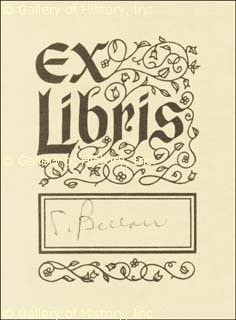
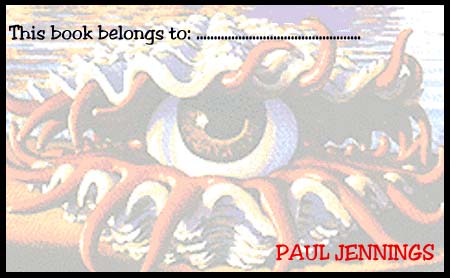
What is a book plate?

A book plate (the personal library version) was highlighted on Rosina Lippi's blog, but here are some pictures of other plates:


As for Avery stickers, they are fine as long as they are something that bookseller wants to use. If I could get ahold of avery stickers with a lifetime supply of Gregory Maguire or Christopher Moore's autographs, I'd be alllllllll about those avery stickers.

Throwing Book Plates (What a Way to Spend My 100th Entry)

I once went to a Greek restaurant for a friend’s 21st birthday, and they had us break plates on the dance floor in celebrations. Great stress reliever.

Throwing book plates, on the other hand, doesn’t really do anything since the paper just flutters out and floats down in a very unsatisfying way. I know this because yesterday I tossed an author’s book plates.

Insert your yelling at the evil bookseller here. Go ahead. Get it out or your system. It will make you feel better. I’m sure I kick puppies too. Just allow me to post the scenario before you hit the comment button.

You see, this author had called my bookstore during my lunch rush. Not a good time to call. If I had my way the phone would be turned off between the hours of twelve and two but then I couldn’t help customers. For future reference, the best time to call is in the morning because a.) someone with authority had to open the store (even if they are just a keyholder they can at least take your vitals) and b.) there aren’t as many people flooding in demanding attention.

Lunch time? Not good.

To add to that author calls when both of my registers are out of commission—one jammed and the other out of paper—and there was a long line of customers. I know that the author didn’t know this, I’m not blaming her for calling.

Hey, I like calling instead of just showing up and then looking disappointed (not to mention making me feel bad because you look disappointed), but said author was obviously prepared to do the hard sell going straight into their speech when I answered the phone. They didn’t even stop for breath (and therefore giving me a chance to jump in) until they’d reached the all important, “and I can give you my ISBN so you can look it up on my computer.”

At this point I explained that while I would love to, I was in the middle of fixing registers and my coworker was on said computer (the only thing still working, a miracle), and I couldn’t. I asked politely if I could get a number to call her back at a more convenient time—something I would have done. I don’t believe in the brush-off.

“No, no,” said the author, “just let me give you my ISBN.”

Halting my search for actual register tape with the company logo on it, I repeated my “let me call you back at a better time” request, but also scribbled down the ISBN number (after asking for the publisher).

“I really have to go,” I told the author. The book natives were getting restless.

“Oh sure, just let me know how many signed book plates you want me to send.”

Say what? I hadn’t even checked the book. I didn’t know if we carried it or if I could even order it. I had a line of customers, a stressed-out coworker, registers that weren’t working, and it was the freakin’ lunch rush! All of which I had explained to the author twice already in my best customer service voice. But now she wanted to know about book plates?

“I don’t know,” I finally said.

“Okay, I’ll send six.”

Six?

Before I could point out that this was a rather high number for a book I didn’t even know if I carried, the author said goodbye and hung up. Fine. Whatever. I got back to my work day.

But in the back of my mind, I kept thinking, “book plates?”

Oh, and not only did we not carry this author’s book, but I couldn’t find it in the system.

Still I was kind of looking forward to these book plates because I like book plates. I remember having these really pretty unicorn ones when I was nine and being obsessed with making sure everything was marked as MINE. Book plates had the potential to be kind of interesting.

I wondered if the author had them designed with a funny saying, or cool picture that tied in with the book.

I wondered how big they were.

I even considered the fact that if they were cool, I might go out of my way to get this book in through the secret bookselling back door of ordering through Books In Print.

Sadly, all my hopes were destroyed when we finally received the envelop (several weeks late due to a mailing error on the side of the post office), only to find it filled with cheap adhesive name tags. You know, the ones you buy from Party Supermarket with the ugly border. The ones that can’t be attached to suede or silk or anything other than plain old, indestructible polyester because the adhesive will gob off on the fabric.

Yeah, those.

For a book we didn’t have.

And to complete the bad high school reunion look she’d signed in marker.

Is this something that they are telling authors? That you should use cheap name plates? I mean, sure they have slightly more use than a bookmark, but come on people? Cheap adhesive name tags as plate stand-ins?

My little unicorn name plates would whinny in shame.

But perhaps I’m being too sensitive; she did call at an awful time.

Your thoughts on all of this?

Tuesday, February 14, 2006

Tears for Fears in Self-Publishing

I meant to post earlier on the topic of self-published books, but then I would get distracted by other subjects. Fortunately Ron Franscell wrote this thoughtful comment on my Doing My Homework #4 thread:

I occupy this rather odd niche: I am both a daily newspaper editor and a trade-published author. I am sympathetic to the promotional predicament of authors, but also a gatekeeper for what's news (and what isn't.) Those two sensibilities collide when a local writer sends his press release about a new book.The main elements of a good newspaper story will be local relevance, timeliness and impact.In a market area of some 350,000 people, we get 1-2 notices of an authentic trade-published book by a local writer every few months ... but we get roughly 1 per week from self-published writers at AuthorHouse, iUniverse, Xlibris and others. These releases are always seeking reviews and/or publicity about signings.Do we treat them differently? Yes. We simply deem self-published books -- by virtue of having circumvented the strict filters of trade publishing (which can be too strict and too commercial, admittedly) -- as lower quality products. Not always, but generally true. By the same token, we deem trade-published books as having survived the rigors of having found an agent, an editor who'll risk a publisher's money, and legitimate distribution -- as well as the expectation our readers will be able to find it in major bookstores.What do they get? We don't trash the self-published books, but rarely do they get more than one paragraph, and it's usually in a "story" about other self-published books. And we name the animal: We say in print it's self-published. And we never review it. (If you're self-published, not local, and the book is not of local interest ... don't waste my time and your postage.)The trade-published local author/book generally gets much more: A story, possible review, a fair punch on a local signing. Why? We presume the rigorous filters of the trade tested its mettle.Not every paper has a trade-published writer in charge (and some probably have self-published authors in charge), so policies vary. As a book-reviewer who's written for some of the biggest book-review outlets in the USA, I also know that the likelihood of a self-published book getting a major review is next to nothing unless it becomes a news phenomenon on its own.

On a bookstore level, especially a chain level, we feel the same way. To date, I can think of only one self-published book that has made it into my store and sold successfully. It was a restaurant and shopping guide book written by a local woman (with a graphic design background, yes this is important) with friends in high places. And when I say self-published, in her case I mean actually did everything herself and managed to produce an attractive book due to her design background (still needed a better editor, but she fixed that in later additions). With the help of her friends, she managed to get on a local morning show, along with a radio show or two, and pump up the demand for her book. By the time the eighth person asked us if we had it, and after the fifth phone call to our sister store, we knew we had to break down and order the book.

By creating a demand, she not only got picked up by all the large chains in the area, but by a distributing house, and all the independent bookstores.

She is not the norm.

Nor is the woman who just received the million dollar deal for her self-published Mary Magdalene trilogy. Kathleen McGowan’s the lottery winner of the self-published set. She and G.P. Taylor represent those people who maybe would have been published by a big house eventually if they had kept submitting (and editors weren’t over-worked and under-paid). What helps in both of their cases is that they managed to create their own publicity, do their own marketing, so in the end they are actually giving a publishing company a book with most of the work already done. It’s an almost perfect package just missing the bow.

When I receive self-published books at the store, or the marketing information for a self-published book, it always makes me a little sad. Part of me just wants to hug the author and tell them that I understand, I really, really do, but I know that this hug will be followed with the comment, “but I can’t carry your book.”

What a slap in the face.

The truth is, when it comes to chains, it is really hard to get anything in that has not already been filtered through one of the big distributions giants like Ingram and Consortium. For the most part (and perhaps completely, I’m not sure so I’m qualifying), my company ships through Ingram so if you are not on the Ingram or the Baker and Taylor list, I cannot order you in. Further more, while my giant sister stores have expense accounts specifically created for purchasing books at that level (in case they run out of an authors book during a signing and need to buy some from the author, or in the case of the self published local woman, needed to buy her book from her), but I have nothing but the cash in my drawers.

I realize that my company is not going to send me every book that is in demand in my area—when your corporate office is 2000 miles away they have a hard time keeping up on the local interests—but that’s why I can order from other distribution centers. Still if your book is not in demand, but also not available to me to order, there is nothing I can do for you.

I know that this is different for independents on both the large and small scale. The Santa Cruz Bookshop and Powell’s have different buying ideals, and their buyer is also on site. They might be willing to pick up a copy or two of your book, so you have some place to send those who are interested, whereas I do not have the space or the permission.

Like Ron, I’m not against self-published books, but I do treat them differently. I’m not going to sit an author down and tell them why their book can’t be on my shelf, or go over the quality of their paper, print and editing. This is their baby and they wouldn’t hear me anyway. I’m just going to politely decline or tell them I can’t due to corporate’s structure.

I realize that this might mean I’m missing the McGowans and Taylors of the world, but I already cannot keep up on my reading. One or two missing from the stack doesn’t bother me that much. I long ago acknowledged that I cannot read every book in my store, let alone all the books in the world.

What I’m saying is, if you or someone you know really believes in their book and their writing, don’t turn to self-publishing. Keep submitting. Look to some of the smaller, quality houses. Really target what your book is about.

And don’t make me cry by sending me a Press Release or a copy of your book from iUnivers, Xliberis, or AuthorHouse. You have better things to do with your money than give it to a vanity press.

Booksellers? Readers? Writers? What are your thoughts on the current state of the self-publish universe?

Monday, February 13, 2006

SB Day: My adventures with True Crime and Gennita Low

It’s Smart Bitches Day once again, so as Beth says:


Write it!

Post it!

Comment to let us know!

Bask in the glory of your inner bitch!


To this I add, please feel free to bitch about anything book related, not just romance (don’t like the basic tenets followed in SciFi or Fantasy? Annoyed as all hell by the latest Patterson? Don’t get the popularity of the Jessica Fletcher novels? Let it out!), and go ahead and post your link here. You can be a smart bitch no matter your gender. It’s an honor, Man.

Oh yeah, and while you're at it, add any links to any--I repeat--any book review sites you know of no matter what the genre or grass-rooted-ness to this post. Let's all build a link archive together, shall we?

That said, let the bitching begin!

In the interest of full disclosure, I must confess that I went through a True Crime phase when I was twelve or thirteen. I’ve always been fascinated by people and their behavior—legal and illegal—so one might think the natural progression to being a True Crime reader was always there, but I had an inciting moment: someone told me that Ted Bundy killed girls with straight hair, parted down the middle.

This freaked me out because I had straight hair (sometimes), and it parted down the middle (all the time). Suddenly I was convinced that Ted Bundy was going to come and get me. Sure he was in jail and on death row, but who knew when he would break out in a daring escape facilitated by a toothpick, a sheet and one well-darned sock, and come and get me! I had to be prepared. I had to read up!

Being the geek with an overactive imagination that I was, being uninformed was not an option.

Some might claim that this early exposure to actual documented violence (as opposed to fantasized video game/movie violence), might have tweaked me somehow, desensitized me to violence in the fictional form, but this argument is flawed. Reading True Crime, with its “just the facts, ma’am” relation of horrific (and now often sensationalized) events, let that wild imagination fill in the blanks. This, combined with events in the lives of those around me, actually left me with a very clear set of rules when it came to reading violence in fiction.


  • Less is more, always. No exceptions. The mind will fill in the blanks and the depths the human mind can plumb with are terrifying.

  • Very few people write violence well. Maybe its my police jargon upbringing, but often it seems that the narrator overcompensates by becoming too descriptive or just outlandish.

  • Often writers tell, not show, and in that telling they lose the impact, or abuse the situation.

  • When writers use “ripped from the headlines” plots, many become to focused on the research they put in, and it detracts from the character I should be pulling for (again, this is not all writers. See Tess Gerritsen for an example of how it should be done). I’m not reading for an info dump. I’m reading for a story, and one of that story’s plot threads just happens to be immediate in today’s world.

If these seem to contradict each other, I can only say that it is because a good author can get me to forget one of my points. A well-written story is a well-written story no matter the subject matter.

And I have just read a well-written story.

Gennita Low contacted me a few weeks ago and asked me if would be interested in reading an ARC of her latest book, Sleeping with the Agent. She was in the midst of switching publishers, wanted to get a handle on her own marketing situation—something I obviously approve of—and was trying to get her book out there to be reviewed by actual readers on the web. Since it was already out in stores and I had yet to set up any intermediary addresses to keep my anonymity (which I have now done), I told her I would try to grab a copy off the shelves. She cautioned me that it involved human trafficking, something that some readers might find offensive, and I have to admit that this gave me pause due to the points above.

It shouldn’t have.

Sleeping with the Agent, the third in a trilogy involving a SEAL/CIA (a branch known as GEMS) joint operation. The heroine of this book, Llallana Noretski, was one of the villains of the last novel (occupying a gray area as she was not completely responsible for her actions), and Reed, her hero, was on the SEAL team of one of the men she betrayed. Lily, as she’s known to her friends, was a former sex slave at an Eastern European brothel who was rescued by the CIA. Instead of just rehabilitating her and sending her on her way, Lily was brainwashed into believing that not she, but a non-existent sister was the sex slave (and still was), and turned her into the ultimate sleeper agent. Lily was a weapon and didn’t even know it, until she was triggered in the last book, betraying her friends, knocking out her lover, and almost blowing up a UN meeting.

Needless to say the woman has baggage.

What makes Low’s character different from all the other female characters with horrific pasts in romance is that Lily has done horrible things, and is willing to still do horrible things to protect the young former sex slaves in her care. Meanwhile she’s dealing with wondering if she’s crazy, whether she’ll be triggered again, and a flood of memories the CIA had locked away inside of her. In the hands of less gifted author, Lily would have dwelled, she would have been all inner monologue and no action, we the reader would have been subjected to revisiting the same horrific subject over and over again—in detail—until we threw the book against the wall.

Low doesn’t do that—at least not in this book—she gives us the “just the facts, ma’am” in Lily’s own voice. She shows us that this is a kick-ass, responsible, driven woman who has been shaped by her past and is working on letting it rule her. She allows Lily to come to the realizations that her unknown past had always been affecting her life just was we do.

And what I’m most thankful for is that she doesn’t try to convince us that Lily was a sexually scared woman just waiting for Reed to awaken her. She acknowledges that Lily has had other lovers, that sex was a form of dominance for her over her partner (a way of getting some back), and that she knew that something was wrong with the picture. What Reed offers her is different because he’s focused on her, and not his own needs, and gives her options.

It’s clear that Lily is forced to trust him early on (hey, they jumped off a ledge and into a river together), but it is a trust that he would have eventually earned without the dramatic event.

The human trafficking and the sleeper cell threads weren’t just plots, but elements that added to the characters on the page—specifically Lily’s character. Reed’s character, in this way, came out a little less defined (in this book at least) simply because his character had been shaped by earlier, and less trigger point, events. His relationship with Arch (his father figure character) and his mother was not as well defined as Lily’s past, because it wasn’t the subject of international espionage. Due to that his revelations later on in the story seemed out of place with the flow of the plot, perhaps because this is a book with so much happening on the international level.

While the book wasn’t perfect (I felt I was missing something by having not read the earlier books—which I will now do—that there was a slight underdevelopment of Reed’s character, and a few moments that went from limited pov to omniscient—a pet peeve of mine), it accomplished what it set out to do: take a gray character with a “ripped from the headlines” plot and make it a fast-paced, educating, enjoyable read. Low’s handling of her sensational subject matter in a tasteful, plot perfect way, along with the development of Lily’s characters as someone we want to cheer on, takes what could have been a wall-banger in less skillful hands, and turned it into an exciting end of what must have been an action-packed series.

Romance readers, who claim to read for escapism and not real life, should not be deterred from picking up this series. They’ll be missing out.

And no, this is not my True Crime infected brain talking. I ended that stage years ago, when I realized if I wanted True Crime I could just open up the paper or walk down the street. Obviously I like a little escapism too.

Saturday, February 11, 2006

What a Girl Needs...

I have a favor to ask y'all, a need to use your combined knowledge.

No, not to build my evil empire of doom, that comes after the indoctrination, head shaving, and implants.

Duh.

What I need from you internet saavy folks is your help combing the 'net to find reader review sites for all the different genres, fiction and nonfiction alike. I need you to pick your brain for this knowledge and then copy and paste the URL, site name, and genres reviewed (reviewer too if you can) into a comment box. I will then take said knowledge, break it down by genre/type, and place it in the side bar.

Together we can build a greater tomorrow, and a resource for writers who want to get their book out there on the web. In celebration of this great plan, I will also find a way to start accepting ARCs (because I want to love them, and squeeze them, and hug them forever), so that I can get in this reviewer game. I will also accept chocolate, diamonds and non-sequential bills, but I figured y'all knew that already.

If something like this already exists (and it might because there are many, many people in the world that make me look dumber than dirt--if indeed dirt is dumb), please let me know and I will just link to that with a big announcement for writers to go there because obviously their cool. It would make my job a lot easier.

A million thanks in advance to anyone who responds.

ETA:

I should probably add that I meant reader blogs and review sites alike, although I'm slightly more interested in reader blogs as they represent a kind of grass-roots marketing that I find intriguing on many levels. Any and all genres are welcome, fiction and nonfiction alike, so bring it on. As for contacting me about possible reviews, ARCs or where to send their five-pound chocolate bribe, all someone has to do is click on the email link/button in the sidebar.

Wednesday, February 08, 2006

Getting personal...guarantees

In response to my post on how to find and approach independent booksellers, Jarvanpa responded with advice that needed to be shared with everyone (I’m never sure if people are obsessive comment followers like I am).

Being now cozily nested in a used/rare bookstore (and not having to worry at all about author tours) I can smugly sit back and recall my past--I used to manage a bookstore that was in a rural, but educated area, carried new books, and did author dealies sometimes.What I found (Eileen, are you listening?) worked for signings and readings and such was enlisting the help of the author in compiling a likely list of people who might want to come. Now, of course this works best if you are (or have) a local author who has local friends, but if the store does mailers (mine did) and you have an intelligent, sensitive manager (yes, I was) you can come up with such a list, based on knowledge of book preferences and so on. You send these nice people handwriten (2 t's? one? god, I hate spelling) invitations by mail. Need not be elaborate, but they must be at the very least hand addressed. And you put little articles in local papers, and posters, if you can, spots on the radio, and so on. But the real key is that personal touch. And then figure--if you are fortunate, unless the author is, say, a sexy movie star--that you will get about 10% of those you mailed to come to your event. Phone calls are also, sometimes, okay, but can backfire (you must know your clients).

Of course, if you are a blatant outsider simply come to enlighten the local yokels you will have to figure out how to seduce your bookseller (actually, or metaphorically). ‘Tis an art. I did resent the persons who hopped in on a busy day and had a stack of their self published bad book that they wanted to sell me and asked if maybe they could have a signing. (now, if the books had been great, I might have been less sour--but even so, I would have appreciated a preliminary letter, and perhaps an arranged appointment to talk over tea.

Oh--in arranging an author appearance/reading/signing--give yourself at the very least a month's prep time.*


Yes, yes, a thousand times yes. If you are going to promote yourself it takes time, effort and that personal touch. This means more than the gimmicks and the bookmarks and adds to the overall impression of your book. Yes, your book should be judged solely on its writing and content, but we’re human and we form our opinions from a multitude of sources, so you have to be the driving force to make your books stick in the readers’ minds.

Someone who does this (with results) is Joe Konrath, the author of the Jacqueline “Jack” Daniels mysteries. Here is a man who not only knows he has to represent himself, but goes out there and does it. His advice on having a sales pitch is dead on:

The secret to sales is to not make it selling.Huh?Concentrate on value, and what you have to offer. Focus on the experience you're giving, not the cost.Sales isn't about looking for buyers; it's about finding the people who are looking for your product even though they don't know it yet.Be funny. Be confident. Be genuine. Be memorable. Be enthusiastic.In person, I've found the best trick to sales is listening to the customer. Not only their needs and wants, but what they had for breakfast, how their brother in Duluth is doing, and what their favorite TV show is.


Whenever I sell a book, I always use the line, "You'll like this, I promise." This assurance takes the uncertainty out of a purchase, and makes the customer feel like I'm doing them a favor, rather than they're doing me a favor.

Let me make this clear. This isn’t about being fake. This isn’t about being schmoozy in a greasy used car salesman kind of way. This is about letting that enthusiasm that carried you through the writing process, that drive that got you to write those queries, mail those agents and publishers, and finish those revisions flow over to the person you are talking to your book about. You are your own best salesperson because you are the only person who intrinsically knows all the ins and outs of your books.

Because, you know, you wrote the thing.

And promising a person they will like it? That’s not a lie, if they stayed through your presentation they probably will. If you’ve made a connection between the hi, hellos, how-are-yous and what-brings-you-in-todays then you are already in, but people need reassurances. That’s why we have blurbs on book covers, that’s why we have reviews and newspaper articles. People need to know that they are making the right choice, and telling them that you promise they’ll like it works.

I tell customers all the time that if they don’t like a book they can return it.

“Really?” they say.

“Sure, just don’t drop it in the bathtub.”

Suddenly that book they were on the edge about or that author that they weren’t quite sure they would like becomes an attractive and desirable purchase.

“I have the right to change my mind,” they think. “But it must be good because why else would this person offer.”

I’m not asking for you to change your basic personality and become a loud, bombastic self promoter complete with bullhorn. Bookselling on any level is about listening and responding.

It’s communication, a relationship, something that you’re trying to build with your readers anyway through your book.


*Ron, there is a quotes button between the bullets button and the spell check button on my edit/create posts box. I simply highlight what I want quoted, hit the button and then fix any formatting errors that occur.

Tuesday, February 07, 2006

Cover Me!

This is just real quick post before I run off to the gym to highlight some great cover designers out there. I recently ran across Dan Dos Santos because of his work on Patricia Briggs’ book, Moon Called, and lo! his site has a tutorial of cover design goodness (but it might take a bit to load). Just as I was wondering how the hell I would work this into a post, the Canadian author Ami McCay comment on the William Trevor cover and mentioned that she’d interviewed her cover designer, and I thought to myself, “Self, I’m sensing a theme.”

Then I thought, “Oh crap, talking to myself is a sure sign I’ve been living alone for too long,” and took out an ad for a roommate.

But the theme, it was there and since I have exactly two minutes before I need to make for the gym I thought I would share these finds along with one of my favorite cover designers of all time: Marc Yankus.

So yes. Enjoy. May these bring you many hours of goofing off at work, and I’ll try to post something at least semi-profound about book retail when I get back.

Sunday, February 05, 2006

Doing My Homework # 4: Getting to know your (bookstore) neighbor

On the “And Now We’ve Reached the Question and Answer Portion of Our Presentation” column (which is still open to questions) anonymous asked:

How can authors get to know independent booksellers in cities other than their own?

S/he asked this question before many of the others I’ve answered, and I know it appeared that I ignored this person in their anonymity, but that was not the case. I only hope that this poster is still around to read the answer. I had a pretty good idea, but it took me awhile to sit down and do the research.

The American Bookseller Association’s website has a membership directory divided by state and province (yep, Canada gets some love too) and then further divided down to cities. By clicking on the link for your desired locations, you can get a listing for any independent bookstores in the area.

As an example, let’s use Pasadena, California. By clicking on the link for California, and then over until I found Pasadena, I can see that there are six independent bookstores that associate with the ABA. After reading the descriptions provided I know that most of these stores specialize in a certain type of book (psychic phenomenon, travel, technical), so Vroman’s Bookstore seems to be my best bet if I’m an author of genre fiction. With this knowledge, I would then write them a letter about my book and how I think stopping by the store would be beneficial to us both, and send it off. Be sure to include the information on how to contact you (via phone, email, etc).

You’re only out the time it took to write the letter and the cost of postage (if you even send it by mail at all, there’s always email).

Do not send a form letter that is completely devoid of anything specialized to the store if you want their attention and patronage. I realize that form letters are time savers, and the majority of the letter can be form, but you have to show these people that you paid attention to their store’s preferences instead of just blithely blitzing everyone in their area.

Any booksellers reading this, do you agree or disagree? How would you prefer to be approached by an author looking for some love?


*****

I didn't forget about the A Bit on the Side cover post; I just decided it was easier to add my thoughts and such to the already existing post. Looking forward to your response as always.

Saturday, February 04, 2006

Opine away.


Take a look at this cover and give me your thoughts and feelings. What's the first thing that strikes you about it? What would you change (if anything)? Does it make you want to pick up this book and why? Or maybe, why the hell are y ou asking this?

I'll give my own opinions after work.

Edited to add:

I meant to get back to y'all when I got home, but blogger was experiencing much unhappiness. Oh well, bet late than never, right?

I chose the William Trevor novel because I wanted to segue into a column on selling short story anthologies and I happen to love that cover (and the book). I found your comments and idea so interesting though, that I think that’s where I should focus instead. Not one of you remarked on the fact that it says “stories” on the cover, which might be indicative of the fact that the picture is small (although you can click on it to enlarge), but I find it remarkable given the fact that a couple of you recognized the name (although larger, it is positioned above his other title and the word “stories”).

For those of you who don’t know who William Trevor, he’s an Irish novelist (currently living in England) whose book, The Story of Lucy Gault, was a Los Angeles Times Best Book of 2002 and a New York Times Notable Book pick. He’s known for his prose (beautiful) and his ability to craft stories that are both gentle and insightful as they exam the often darker side of human lives. A Bit on the Side refers to the title of the last story about two people having—and ending—an affair.

What I love about this cover is that it does attract so much attention and opinions even though its not bright or eye-grabbing (despite the use of that lush purple for the woman’s blouse/dress, which I’m not sure comes through in the picture I used). The photo was done by Stephen H. Sheffield (Photonica) and then hand colorized by Viktor Koen.

I thought about cropping out the title or just the author’s name, and letting the cover stand on its own merits, but that’s now how you would see it in the store. I doubt that the publishing company had the time to get the feedback that you’ve just given me, but imagine if they had. Would they have changed anything? Probably not, it is a lovely cover.

Does it represent the book within? In my opinion, yes. Trevor’s stories have this same kind of soft quality, as if they could take place anywhere in time. It’s not the time period but the issue that his characters deal with that’s important. I think that you showed that this came across in the cover with your comments (and whether or not this type of thing attracted you). Books, like opinions, don’t appeal to everyone, and so covers cannot appeal to all.

But if this cover has caught your interest, check it out. His stories are amazing.

I’ll get to the “short stories and how the sell column” later this week.

Friday, February 03, 2006

The Dark Side of Valentine’s Day

Valentine’s Day. A day Hallmark and many others has convinced us means romance and love, a day to show someone you care about them through some sort of memorable occasion. It’s synonymous with candy, hearts, and roses; Cupid and Aphrodite; love. All things romantic.

But it also has a dark side. Ask any woman whose heart has been broken just days before the date because her partner felt that they couldn’t live with the lie during V-day. Ask any man who has been left by his partner for another. Ask any girl who has stared at those long aisles of pink and red, dripping in chocolate and flowers and realized that the longest lasting relationship she’s ever had has been with her heating pad.

Valentine’s Day: it’s not all candlelight, chocolate and oral pleasure.

The Boss and I, being the bitter, jaded book-hags that we are, decided to this dark side must be acknowledged. People needed to know that they weren’t alone, that others cringed at the very word Valentine and desperately wanted the fourteenth to pass without incident. For in our bookstore the start of February was heralded with the sounds of hearts breaking across the state, and slowly they began to drag themselves towards the self-help section.

“He broke up with me because he said I was too old for him,” one woman told me.

“She said I just didn’t understand her needs,” another man said.

For every perky couple browsing the relationship section for the newest book on sexual positions for the romantically inclined, there’s some poor soul limping into the store with a general look of “what the hell just happened?” mixed with “I was just hit by a semi doing sixty around a steep curve and it rolled over my ass.”

It was for these folks that we created the “Dark Side of Valentine’s Day” end cap. It’s not on any promotional planner and it doesn’t follow any planogram laid out by the company. It’s just a collection of titles we think call to those who’ve been through the hell of being dumped right before Valentine’s Day.

The first year we decorated it with the classic break-up lines despite the company’s strict “no handmade signs” policy, or slap-in-the-face comebacks to the “love lines” of all time.

“I feel like you see the real me.”
“Yeah, and I’d like to see less of you.”

“It’s not you. It’s me. Well, okay, it’s you.”

And so and so on. Our top seller that year was Why Do Men Love Bitches? by Sherry Argov. The next year it was He’s Just Not That Into You. This year, in an attempt to add a little humor, we put up the Sweet Potato Queens’ Wedding Planner/Divorce Guide, and we’ve seen a spike in sales for It’s Called a Breakup Because It’s Broken.

There are other books on the end cap, other trends I’ve noticed, but I’ve got to get ready for work, so instead I’ll ask y’all for some input.

What’s your top breakup book of all time?

What’s the pick-up line/breakup line that makes you cringe and your own sarcastic response? You know, the one you are thinking in your head as it happens, or come up with later when you are getting blotto on wine and pouring your heart out to your friends.

This is equal opportunity and open to both sexes, so bring on the answers. There are still eleven more days until Valentine’s Day for me to get this end cap right.

Thursday, February 02, 2006

Doing My Homework #3: Fear and Loathing in the Bookstore

On the Questions thread, Paul asked:

What popular books do you loathe so much that your soul winces when you are
asked about them?


Tuesdays with Morrie.

I know that people love it. I know that they looooooove to give it to other people as a gift. I know that it must have something valuable in it because people keep coming back for it, but for the love of all that is chocolate, make the insanity stop!

It jumped back on my bestsellers list this week.

Yes, that’s right. It’s been out since October 2002, but now it’s back on the bestsellers list to taunt me with its presence.

Doesn’t everyone who wants this book own it already?

That said I realize my opinion is not the popular one, nor is it the most monetarily pleasant as far as the bookstore goes, so I keep my mouth shut. We all do. There is a general loathing for all things Morrie at my store, and after we sell another copy it all comes out.

“Who the hell is s/he going to give it to? Do they live in a cave?”

“Maybe they just learned to read.”

“Just watch the Lifetime Movie, bucko. It won’t take as long.”

And so on and so on. We wait for the customer to leave the store, of course, and we make sure no one is around to hear us. We realize that everyone has their own reading tastes, and most of our contempt stems from Morrie always being there. In large quantities. Quantities that become even larger over Christmas and Easter.

Someone at the company looooooves Morrie and obviously doesn’t have our problems.

As for other books, none reach the levels that Morrie has inspired with the exception of Melville’s Billy Budd, a book whose mere mention causes me to apologize to any customer who has to buy it.

Customer: I’m looking for Billy Budd.

Me: I’m sorry.

It’s either that or scream, “Dear God, Why?” which I’ve found weirds people out.

Weirding people out does not translate into book sales.

For the most part, I don’t form an opinion either way about bestselling books unless I’ve read them and I rarely ever loathe books I’ve read (exception: see Billy Budd). Occasionally Harry Potter does make me want to stab myself in the eye, but that has more to do with people asking me the same question over and over.

In reference to HP6 on the release day, “Why isn’t this out in paperback?”

In reference to HP6 a week after the release date, “Shouldn’t this be out in paperback by now?”

In reference to HP6 a month after the release date, “No, my husband/wife/daughter/son/cousin-twice-removed said it was out in paperback. I want the paperback. Where is it?”

And so forth.

For the record Harry Potter does not adhere to the eight to twelve month rule when it comes from the transition from hardcover to paperback. The cynic in me says Scholastic will milk you for all you are worth, and that’s why they wait so long to release HP into paperback, in reality they seem to have timed the last two releases to coincide with the Christmas season. I have no idea when HP6 is being released to paperback, if I had to guess I would say possibly this November. I also have no idea when HP7 is coming out, what the title is, or what happens.

We will all probably find out at the same time on the evening news.

How about y'all? Any books that make you want to drive an ice pick through your temple? Please share and know that you are not alone.